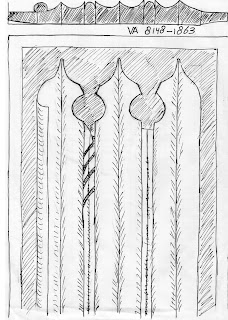
Original real medieval trestles (not the X-trestle tables or the trestle tables that have a horizontal support between the two trestles) are extremely rare. There is a table top with several trestles in the museum Onze Lieve Vrouwe ter Potterie in Bruges, Belgium. The Musee des Arts Decoratifs in Paris, France has a table top with two trestles on display, as well as one trestle hidden somewhere in the depot.

Finally, when I started preparing this blog I did a quick internet search on trestles and found an early 16th century set of trestles originating from the UK, also with the legs to the sides. These trestles are the most simple in their construction, and made of heavy oak. Similar type of trestles with side legs are often found in medieval illuminations and paintings. Interestingly, one of the English trestles has four legs, instead of the usual - more stable - three.
Bruil and Brandsma, the Netherlands


Sutton Hall, United Kingdom
The Sutton Hall trestles (and tabletop) were on sale at an English antique shop (Period Oak Antiques). This table is one of two identical tables from the great hall of Sutton Place in Guidford, Surrey, UK. Sutton Place was a great renaissance mansion build by Sir Richard Weston, a loyal and influential courtier of King Henry VIII. It is believed that these two trestle tables have been in the house since its construction in 1521-1533.

The two trestle tables as seen in their original site in Sutton Place hall.
The tables date from the 16th century. The table top consists of a large 10 feet long hewn single plank of English oak 4" thick and 30.5" wide. It stands on two trestle supports: one with four legs, the other with three. The trestles are of very simple construction, bascially a large block of oak with the legs sticked into it. The trestles are undecorated, except for the initial JW found at one of the ends of a block.


Bruil and Brandsma are greatly acknowledged for their permission to take photos and allowing them to be published on this blog.