Monday, 27 November 2017

Thomasguild live on radio at the Engelanderholt

Bram explaining the construction of the klaarbank at the Herenhul during the 'Gelredag'. 
Photo Omroep Gelderland (twitter Ridders van Gelre).

Remember the medieval 'klaarbank' or judicial court at the Herenhul or Engelanderholt on which we did a project for the 'Geldersch Landschap and Kastelen' or GLK (see some previous posts)?  Well we were contacted again by the GLK for this historical place. The local radio and TV channel (Omroep Gelderland) has a ongoing series called 'Ridders van Gelre' ('Knights of Gelre') on the history of our province. This time they made a TV show that featured the medieval judicial court at the Engelanderholt. This TV show is always followed by a live radio event the next Saturday at the premises, where several lectures are given and the site can be visited. We were the most likely candidates to visualize the klaarbank ...

The announcement on the website of Omroep Gelderland for the Gelredag at 
'the most important site of Gelderland during the Middle Ages.

Setting up a 'klaarbank' early in the morning for only a few hours and then dismantling it again is a daunting challenge - in medieval times it took at least 2 weeks to construct it. So what we did instead was making a live-size rope model of the court, which gives a good impression of size and height of the klaarbank. Omroep Gelderland (ridder Rene) was present when we set up the rope model, as well as when the first group of visitors arrived. The GLK provided some staff that helped with the construction, as well as some fresh cut saplings that could be used as stakes. A motor saw was used to cut the saplings at length, while a motor drill was used to dig the holes for the stakes. The layout of the klaarbank, however, was done using medieval tools: a rope with 13 knots (to make a 3-4-5 triangle with a 90 degree edge), a rule and a level. The  klaarbank model was ready before the visitors came; we even had some time for coffee.

 
The live-size rope model of the judicial court. The ropes are at the height of the seating or the platform. The rope ladders show where the stairs are. The stakes at the corners are 4 m high, the height of the walls of the klaarbank.


Clockwise: The side of the klaarbank with the stairs to the platform of the councillors and the Ducal seat. The registrar and the scribe are ready behind the table (with the medieval tools). Katinka with two staff of the GLK next behind the line where the accused stood. Showing the complete size of the klaarbank.

Interestingly, one of the visitors was a local who remembered that the stone at the Herenhul used stand on a different site some hundred meters away, and was moved  to its current place when the nearby motorway A1 was constructed. It appeared that this place was not so historically accurate after all...
Visitors at the Herenhul during the Gelredag. Photo Omroep Gelderland (Twitter Ridders van Gelre).
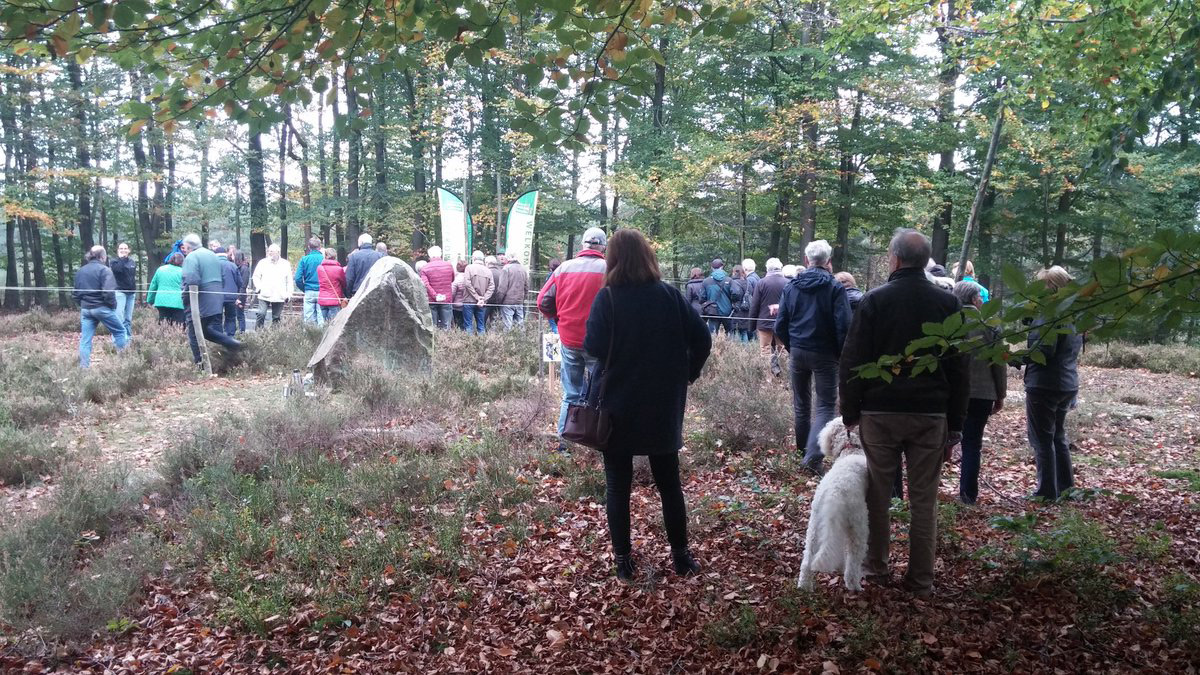
 
Photo Omroep Gelderland (Twitter Ridders van Gelre).

Monday, 30 October 2017

A 15th century oak chest panel

Two 15th century from a recent auction and another one bought several years ago at ebay.
The two panels are 45.5 cm high and 20 cm wide and around 1 cm thick.

It is interesting to look at medieval internet auctions and see whether they have some interesting pieces for sale. Mostly, they are above my budget, but this time they had some affordable pieces at Le Prunier Auction: several 15th century French oak panels were for sale. I did a bid for a pair of panels that originated from a chest and won it! Some weeks ago they arrived at home. One of them was in a bad shape - which I knew from the auction photo - with some woodworm holes. As I did not know whether the panel was treated or not, they went for a cure for some weeks into the freezer to kill the bugs.

 
Wrapped in plastic the panels just fitted into the freezer. 
A few weeks at -20 degrees Celcius is enough to kill any woodworm inside.

The best panel of the two.

A few details of the panels: the roses of the the top.

The gothic windows and the rose in the circle at the bottom.

Compare this with the rose details of my other 15th century panel.

Woodworm vandalism on the other panel.

Wednesday, 11 October 2017

Medieval furniture at Chateau Langeais: dressoirs and armoires

There is more to see at Chateau Langeais than tables, benches and chairs. For instance, cupboards, buffets, dressoirs and armoires (see medieval furniture dictionary). Below is the photographic tour of the castle concerning these furniture types.


This beautiful 6-sided early 16th century livery cupboard was luckily a bit damaged. That is, for me, because it allowed some views of the construction that would otherwise not be possible. The dressoir only stands on four legs.


The sides of the dressoir. The wooden nails in the frame are clearly visible. The top of the dressoir consists of three wooden boards.

The dressoir has only one door, with openwork hinges and lock. Above and under the lock are two faces of men with hats and ruffs, typically worn in the early 16th century.

 Left: The front of the drawer. The two front 'legs' end here in an ornamented knob. Right: The underside of the drawer. At the end a wooden block is placed as a stopper.

Left: Another view of the underside of the drawer. It rests upon two rails. Right: One of the lower side panel was broken, allowing a view inside. You can see the rail on which the drawer rests and the stopper block at the end. Also the groove of the side panel can be seen and the bottom of the cupboard above.
The top has a simple ornamented rim attached to it.

 
 A small but high six-sided  stepped buffet with a canopy and shelves that can be used to display silverware. 
The buffet is made in the late 15th century.

 
The canopy has a barrel-shaped roof  and the vertical stiles end in woman's faces

 
The stepped buffet consists of two loose parts: the display shelf with the canopy and the cupboard with the under shelf.  The backside has two heraldic shields which also appear on the cupboard below.

 The door of the cupboard with two heraldic shields.
 
 Also at the end of the drawer the vertical rails end in woman's heads.

The bottom shelf has six feet.

A four-sided livery cupboard with two doors and no drawers.

The side panels of the dressoir are carved in linenfold pattern.

 A small armoire with double doors. All panels are carved in linenfold pattern.
The top of the armoire consists of two boards.

A large armoire with two large doors and two smaller ones on top. The armoire only has linenfold panels at the front.

The armoire in a bedroom in the castle.

 
 A low livery cupboard / table with two small doors.

Likely not medieval, existing in medieval times: a baby walker and a cradle.