Tuesday, 28 May 2013

The crow's hammer

The crow, a medieval machine of war, used to hammer and break the top of the walls during a siege. It was named after the powerful beak of a bird. Why did we discover last weekend in the Eindhoven Historic Open Air museum....

Two of the hooligan jackdaws

A relative of the crow, the jackdaw is a common inhabitant of the museum premises. Thus-far they were just annoying birds, eager to get their beaks on anything edible that was unprotected: an egg, a piece of cheese, an apple, a rhubarb pie to name a few. This weekend they changed their tactics to a more brutal kind. We had an earthenware milk bowl with dough for medieval lasagne next to the fire, covered with a lid. After the dough had risen enough and the lasagne was rolled and cooked, the milk bowl was left unattended next to the fire. The daws saw their chance and tried to get the remaining dough from the bowl. Tic tic tic did their powerful beaks. And like a modern hammer-drill or the medieval crow, they wreaked their destruction at the hapless bowl... 

 The destroyed milk bowl

So we have to look for another bowl and keep a better eye on the Eindhoven hammerbeaks. 

Saturday, 25 May 2013

Medieval tapestries in the other Luneburger convents

At the end of April we again visited the Luneburger moor in northern Germany to have a look at the medieval tapestries in the other Luneburger convents. Around the Luneburger moor are six protestant convents: Kloster Wienhausen, Kloster Isenhagen - which we visited both last year, Kloster Ebstorf, Kloster Lune, Kloster Medingen and Kloster Walsrode. The last one is not that interesting for us: it had suffered from fire and Napoleonic troops did remove all the old stuff. To the other three convents - Lune, Medingen and Ebstorf - we went.

Kloster Lune in Luneburg, Germany

Altar cloth with the chair of mercy and the symbols of the evangelists surrounded by angels. 
On the edges some Christian scenes. The white embroidered altar cloth is made around 1330-1340. 
 Image from J.U. Brinkmann. Die blauen Bucher - Kloster Lune.

Kloster Lune in Luneburg is the most interesting from the embroiderers point of view. It houses a textile museum with a display of white embroidered white linen altar cloths dating from the 13th and 14th century, as well as tapestries with 'klosterstich' dating from the late 15th century. The 'klosterstich' is the stitch we will use for our Thomasteppich project (the tapestries of kloster Wienhausen of the 14th century also were made using this type of stitch). All the Tapestries on display are religious ones, contrary to those found in Wienhausen - e.g. the Tristan tapestries. They display the lives of saints or biblical scenes. Another difference is that the tapestries of Wienhausen are wall-tapestries, while those of Lune are rugs for use on the floor. This can be seen by the edges that are decorated by rows of tassels, the type of wear on the tapestry, as well as the lack of hanging damage (due to the weight of the tapestry).


Auferstehungs teppich (resurrection tapestry). Measures 365 x 307 cm, made in 1503-1507. 
Image from J.U. Brinkmann. Die blauen Bucher - Kloster Lune. ISBN 978-3-7845-0829-0.


Two scenes from the right edge of the Auferstehungsteppich: a boar eating acorns and a rabbit with young. Images scanned from postal cards.

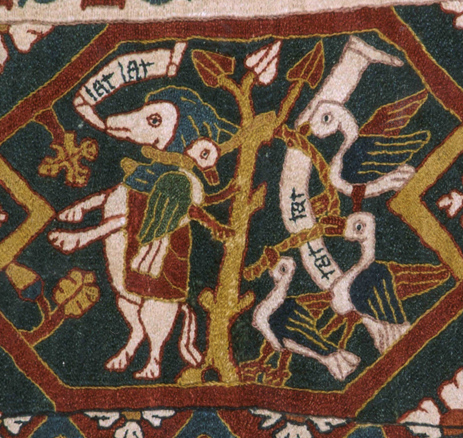
The Sybillen teppich (Sybils tapestry), made in 1500-1502, has some special images on the edges of animals. They are 'talking' an embroidered text, just like a modern comic. On the left and right of the tapestry a cat with young is saying "MAIV MAIV" and on the bottom of there are two scenes of a fox and geese where the geese say "TAT TAT" and the fox as well as he lures a goose away.


 Detail from the Sybillenteppich. The fox is disguised as an innocent pilgrim. The geese say 'TAT TAT'.

 Detail from the Sybillenteppich. The fox has taken a geese as also says 'TAT TAT'. Also clearly visible are the embroidered (red and yellow) lines accentuating the images.Images scanned from postal cards. 

Kloster Ebstorf, Ebstorf, Germany


Kloster Ebstorf in Ebstorf is most famous for its medieval map of the world. The Netherlands is a blank spot on the map, however Flanders is represented. But no tapestries. According to the PhD thesis on the medieval tapestries in klosterstich by Tanja Kohwagner-Nikolai (ISBN 978-3-89975-082-9) there should have been some small tapestries or 'Banklaken' in Kloster Ebstorf. However, during the guided tour no sign of any tapestry was seen. In Kloster Medingen in Medingen near Bad Bevensen much medieval furniture can be found, however only a replica of one small tapestry or Banklaken was seen the the convent.

Four parts of the Moselaken tapestry made in Kloster Ebstorf that should have been in the convent. Made around the first half of the 14th century. Height around 70 cm, lengths vary between 83 -200 cm. Image from T. Kohwagner-Nikolai 'Per manus sororum' Niedersachsische Bildstickereien im Klosterstich (1300-1583). ISBN 978-3-89975-082-9.


Kloster Medingen, Medingen, Germany. Rebuild in the 17th century after a fire, but still with some medieval inventories.

Some of the tapestries that were made in Kloster Lune (and the other convents) have left the confinement of the convent walls. They have been sold to other museums to gather money for repairs or the construction of the textile museum. Some of the Ebstorfer tapestries can be found in the Kestner Museum in Hannover, Germany. The Osterteppich, or Easter tapestry from Kloster Lune has gone to the Museum fur Kunst und Gewerbe in Hamburg, Germany. This museum we visited on our way back to the Netherlands, and luckily, here photography was allowed.

Osterteppich in the Museum fur Kunst und Gewerbe, Hamburg. The tapestry is made in 1504-1508 in Kloster Lune and measures 475 by 420 cm.Most dark and red colours are still very clear.

Osterteppich detail: an angel playing a musical instrument while sitting on cushion on a bench.


The mythological beasts at the bottom of the Osterteppich bear female faces and a text line with some initials. These are the initials of the embroiderers of the tapestry. In the photos here only KR, SU and ESR, are shown, but they are nine in total on the tapestry. The embroiderer ESR has been identified as Elisabeth Schneve Rding (see the thesis by T. Kohwagner-Nikolai for more information).

Also on this tapestry animals, or more specifically birds, with their specific text sounds are found on the left and right edges. A parrot saying: 'Papegoyeke, papegoyeke'; a hop bird saying: 'Up vp vp'; a peacock saying: 'Eo eo eo eo eo'; a cuckoo saying: 'Kuckuck kuckuk'; and some real talking birds saying: 'kindeken kindeken' (child child) and 'servite deo servite deo deo' (serve the Lord, serve the Lord).


The cuckoo on the right side of the Osterteppich saying 'kuckuck kuckuck'.

The talking bird on the left side of the Osterteppich saying 'servite deo servite deo deo'.

Tuesday, 21 May 2013

Revisiting the medieval turned chair of Duchess Agnes

Recently, due to a comment on my blog, I have bought the article of Horst Appuhn that had appeared in the Aachener Kunstblatter band 48 of 1978/1979. The article, Beitrage zur geschichte des herrschersitzer im Mittelalter. I teil. Gedrechselte Sitze, concerned the medieval turned chairs that were in use as seats of authoroty or 'thrones'. It describes four specific examples of turned chairs: the chair of Duchess Agnes in Kloster Isenhagen (Hankesbuttel, Germany), a chair from Husaby (Sweden), the bishopsseat from Gammla-Uppsala in Sweden, and a chair from Gotland (also Sweden). Both the chairs from Duchess Agness and that from Gammla Uppsala have appeared in previous blogposts. However, the article from Horst Appuhn contains such interesting and additional information that they deserve to be revisited in a new blogpost.

The chair of Duchess Agnes from Kloster Isenhagen


Left: The back of the lectern/chair. Right: Front view of the lectern/chair with the door of the cupboard open. Inside you can see the original seating boards of the chair. Black and white photo from the article of Horst Appuhn.

The chair is now a lectern, but constructional evidence, such as open grooves and mortises, proves that it has been originally used as a chair. Conversion to a lectern presumably took place around 1610, when the chair (and the choir stalls) were painted by Master Hanss Godecke from Walsrode. Also the lock of the lectern chest is of later date than the chair. The turned rail that now holds the front of the lectern desk, likely was the front bottom rail of the chair. It has the same marks of use as the the bottom rails.
  
The four posts of the chair are made of oak and have a diameter of 10 cm. The back posts are 1.425 meter long, the front posts 1.18 meter. The other turned parts are made of ash, except half of the small rungs, which are also oak. The large ash rails that connect the posts have a diameter of 5.5 cm. The rungs measure 6.4 cm and have a diameter of around 2.8 cm. The original chair had 6 fields of 3 x 8 rungs = 144 rungs for the back, and for the sides 1 field of 4 rows with 12 rungs and 1 field with 3 rows of 12 rungs = 84 rungs each.

The boards are all oak, as well as the seating (now the board in the lectern chest). The outside of the chair is painted in grey-green, green and red, but the inside of the lectern is unpainted. Here the original, unpainted decoration can be seen. The rows of rungs are either ash or 'blackened' (using fire) oak. The turned ash rails have browned rings at the places where the rungs connect. Also the ash rungs have two browned rings at the top and bottom balls.


Three rows of rungs from the inside of the chair. The top and bottom rows are oak rungs, 
the middle ash. You can see the darker (browned) rings on the rails where the rungs connect.  
Black and white photo from the article of Horst Appuhn.

The construction of the chair holds a surprise: beneath the seating is a chest! The lid of the chest, however is not the seating, but the front panel. To open the chest, it slides upward (with the top front rail). It explains why there are no mortise holes for the seating rail in the front posts, and why there is a groove in the front posts.


Rungs, left original rungs, right restored rungs in the back of the chair. 
 Black and white photo from the article of Horst Appuhn.


The bisshopsseat of Gammla Uppsala


The so-called bisshopsseat of Gammla Uppsala church (Sweden) is dated between 1156 and 1164. The chair has place for two persons, and therefore is also called (and used as) a marriage bench. However, the date of the chair and the location in Gammla Uppsala, a royal place, suggest that this chair may have been a coronation throne for King (Saint) Eric IX.


Left: The bisshopsseat in Gammla Uppsala church. The alternating coloured rungs can be clearly seen. Right: The nearly identical seat from Vaksala kyrka in Uppsala. Black and white photo from the book 'Studier i Sveriges medeltida mobelkonst' by W. Karlson.

The chair measures 118 cm wide at the front, and 112 cm at the back. The depth of the seating is not given, but as the number of rungs is twice the amount of the side, this should be around 66 cm (112 cm - 20 cm for the posts)/2 = 46 cm + 20 cm posts). Height of the posts are 80 cm (front) and 105 cm (back). The posts are connected by flat boards sawn as arcades. The pillars of the arcades are turned.

In total there are 8 rows of 15 rungs (3 x 2 at the back, and one at each sides). Rungs are made of turned ash and are 7 cm high. Half of the rungs are dark brown coloured, the other half blank, in pairs of three in a row, giving the chair a charming appearance.

Interestingly an almost identical 'bisshopsseat' exist in Vaksala church in Uppsala, just a few kilometres away from Gammla Uppsala. Due to the striking similarity, it is likely that both seats were  made by the same workshop.


King and Saint Eric IX of Sweden (reigned 1150, undisputed from 1155 – 1160). 
Image from internet.
 
 
The turned throne of Gammla Uppsala. A good view of the side of the chair is given. The armrest consists of a turned ribbed rail. The photo also gives a good view of the seating boards. Black and white photo from the article of Horst Appuhn.


For those interested in the German article, which contains many black and white photo's of similar medieval turned chairs, you might have a look at the sources-other page, or consult second-hand internet book-shops.

Friday, 19 April 2013

An Italian sgabello

'The so-called Strozzi-chair, above all, a pearl of the collection, a world-renowned uniqueness, a truly enchanting masterpiece, one of the most beautiful Florentine pieces of furniture. Under the hand of an artist - who could not think of Benedetto da Majano? -  the profiling, tasteful intarsia, the magnificent 'schiacciato' carving of the medallions that crown the backrest, which are yet lifted by delicate gilding -  a real work of art has been created. Even in the princely Palazzo Strozzi this chair has been regarded and guarded through centuries as a family treasure.'

This (translated) praise of a three-legged chair from around 1489, now in the Metropolitan Museum of Art in New York (gallery 500), comes from F. Schottmuller in his book 'Wohnungskultur und Mobel der Italienischer Renaissance' from 1921. At that time the chair belonged to the collection of Dr. Albert Figdor. He acquired the chair from the Palazzo Strozzi in Florence. When the Figdor collection was auctioned in 1930 the chair - along with some other furniture - was bought by the New York museum.

This beautiful 15th century chair is made of walnut, with maple, ebony, ebonised wood, fruit-wood and gilded details. The octagonal seat plate rests on three oblique, upwardly rejuvenating triangular edged legs. The also oblique backrest is small and high, and spreads upward. All parts are decorated with geometric intarsia strips. The backrest is crowned by a circular medallion, surrounded by a row of  pierced carved rising moons of the Strozzi crest. Both sides of the medallion bear the crest of Strozzi in low relief (so-called schiaciatto) carving: the front with a buckler occupied by three half moons on a cross bar, covered by a helmet crowned with an eagle with raised wings; the back side has the buckler alone with the Strozzi family coat of arms of the three half moons on a cross bar.

The chair was made by the workshop of Giuliano and Benedetto da Maiano, who were also responsible for the portrait bust of Filippo Strozzi, as well as the sculpture of his funerary chapel, and the designs of the Strozzi palace and its furnishings. The chair is 147.3 cm high, 42.5 cm deep and 41.9 cm wide.


The front (left) and the backside (right) of the medallions of the Strozzi chair. The rising half moons are omni-present in the 'schiaciatto' carving. Images by the Metropolitan Museum of Art, New York. 


The side of the Strozzi chair. You can see that the octagonal seat is enlarged at the back to accommodate the backrest. Also can be clearly seen that the backrest is angled backwards. Image from the Metropolitan Museum of Art, New York.

This photo shows the intarsia strips that decorate the backrest, seating edges and legs.The dark lines are ebonized (painted like ebony) wood. Image from the Metropolitan Museum of Art, New York.

A detail from the intarsia of the photo above.

A modern version of the Strozzi sgabello

In 2006, I did not have these detailed colour images, or had any background information of this famous chair from the Dr. Figdor auction catologue. I only had  one black-and-white photo from the book 'Oude meubels' (old furniture) by Sigrid Muller Christensen, with no more information than that it dated around 1490, that it once belonged to the Strozzi family and that it resided in the Metropolitan Museum of Art. No dimensions were given, nor anything else. But I liked the appearance of the chair, and decided to make two modern versions of this chair, using modern wood glue and finish. For the rest, the construction could be like the Strozzi sgabello, but as said before, the only piece of information was the photo in the book.

The photo on page 55 of the book 'Oude Meubels' by Sigrid Muller-Christensen.

Using this photo I tried to reconstruct the dimensions. I used a standard seating height of 42 cm and based the rest of the dimensions on that. I also guessed the angles (10 degrees) using a protractor. The total height of the photo chair was 109 cm, 36 cm short compared to the real Strozzi chair.


Measurements of the chair based on the black-and-white photo and a 42 cm seating height.


I had some leftover wood from a (non-medieval) rocking dragon I made, which I wanted to use for the two chairs: European maple for the chair itself, and walnut for the intarsia - the opposite of the Strozzi chair. The same leftover wood has been used for the playing board of the 'game of the Four Seasons called the World' described in an earlier blogpost. Instead of a round medallion at the top of the Strozzi backrest I used an octagonal one, also the intarsia decoration used on the chairs was designed by myself.

I made only rough sketches of the furniture I made at that time. I have put the dimensions on a photo of one of the two chairs. The legs of the chair are triangular. The backrest also has an angle of 10 degrees, like the three legs.

The plan for the walnut intarsia at the top of the backrest. The decorative plan for the octagonal medaillon and the seating was drawn more precise in 2006. The dimensions were added in 2012. The two diamond intarsia on the backrest were skipped in the final plan.


The intarsia plan for the seating. You can see that the octagonal seating is elongated at the back to accommodate for the backrest.The walnut triangles at the bottom and the two left and right at the top are the places where the legs of chair connect to the seating.

The two modern Strozzi chairs without final their coating. The chairs were finished with an oil-wax mixture (Osmo Hardwax oil - satin finish).


Two details of the construction. Left: The backrest of the chair is connected to the seating with dovetails, which in turn are fixed by the walnut intarsia strip. Because of the angled backrest, the  dovetails are also set at an 10 degrees angle. Right: The walnut intarsia strip at the seating. The strip is around 3 mm thick. The groove for the strip was made with a router.


The legs stand at an angle of 10 degrees on the seating, which means that the mortise has to be set at the same degree. I used a block of wood set at the same degree to guide the chisel when cutting the mortise. I started the mortise at the top of the seat at the place of a walnut traingle. I then calculated where the mortise would appear at the bottom. After the mortises were made, the legs were glued in and the mortises wedged. At the top of the seating the mortise was covered with the walnut traingle.


Some more views of the chair and the intarsia. The grooves for long walnut strips on the backrest were made with a router, the grooves for the short strips were made by hand.

The intarsia of the octagonal medallion were made by hand. The walnut diamonds were made slightly tapered to fit exactly in the corresponding hole. After glueing, the medallion was planed flat.


Both my modern Strozzi chairs at Castle Loevestein in 2012..

Tuesday, 9 April 2013

Woodworkers guild chests

Not only wills and inventories are are great sources of information for which tools medieval woodworkers used, also images of woodworkers at work with their tools can provide knowledge of how and which tools they used. However, when such images are made by miniaturists or painters one can doubt the accuracy, as the artist does not know the exact working and looks of the tools. But when the artist himself is the woodworker, there can be no doubt that he knows his tools. This can be seen for instance at the intarsia of woodworkers tools at the choir stalls of the San Petronio Basilica in Bologna, Italy, the image of the insarsia worker Antonio Barili at work, or the woodworker on the choir stall of the cloister in  Pöhlde, Germany.

Intasia by Antonio di Marchi showing a variety of woodworkers tools at the choir stalls of the San Petronio Basilica in Bologna, Italy. Images from J.M. Greber 'Die geschichte des hobels'.


Another great image source is the furniture used by the woodworkers guilds. They can be very illuminating by showing the tools they used. You can also be very sure that the tools depicted are very accurate - the makers of the chests are also the users of the tools! The following examples are two Austrian/Tiroler woodworkers guild chests and table with a large variety of tools. Last example is a Dutch woodworkers guild chest from the 17th century from Deventer, the Netherlands with only a few tools. However, what these images do not show is how many of each tool the woodworker owned.

The guild table and the guild chest made by the the Bozen (Bolsano) joiner Hans Kipferle in 1561. Walnut, maple, and other woods were used for the intarsia..The table and chest are supposed to be in the Stadtmuseum in Bozen (Bolsano), Italy.. The table measures 125 x 108 cm.

The table top of the Guild table by Hans Kipferly. Image from Mobel Europas 2 - renaissance - Manierismus by F. Windisch-Greatz.

The tools depicted on the guild table by Hans Kipferle are (clockwise): a frame saw, an auger, a mallet, a try square, a smoothing plane, a claw-hammer, a wooden screw-clamp, a chisel, a straight bevel crossed with what seems to be a depth measuring tool, a bench support, an axe, a shoulder-knife, a compass, a gluepot, a moulding plane, a rule, a double marking gauge and finally in the middle the work bench on which another hammer and chisel are shown as well as some bench hooks.In fact the gauge depicted is even earlier - and more accurate - than those shown in the post on the squantillion.


Front and backside of the Guild chest of the joiners guild of Graz, Austria dated 1600. It is made of walnut, maple, ash and ebony and measures 30 by 50 by 32 cm. It can be found in the Landesmuseum Joahannum, Graz, Austria. The panels on the front and backside show the tools of the joiners trade. Image from Mobel Europas 2 - Renaissance - Manierismus by F. Windisch-Graetz.


The tools shown on the four different panels are: Top left: an axe, a claw hammer, a rule, an auger and a straight bevel.Top right: a gluepot, a compass, a mallet, and a shoulderknife. Bottom left: a frame saw, a square, chisels and a gouge. Bottom right: a crew clamp, a smoothing plane (very similar to that of Durer on his engraving Melancholica), a double marking gauge.


The guild chest (cassette) and lid of the chest of the Deventer woodworkers guild of 20 March 1685 lavishly decorated with geometric carved patterns. At the bottom of the chest is a small drawer. Image from the website of the Deventer historic museum, Deventer, the Netherlands.


The lid of the Dutch guild chest shows only few tools compared to the Tiroler and Austrian counterparts: a hand saw with pistol grip, a try square and a compass. below are an axe and the typical Dutch 'gerfschaaf' a small smoothing or scrub plane. Note that the brass lockplate has been moved.