Monday, 19 November 2012

The medieval toolchest: the shoulderknife

I have told in a previous post on woodcarving knives of the shoulderknife, the knife used for making intarsia. I now would like to present the shoulderknife that I have made recently. The blade was created by the German master-smith David Schütze (Wollschmiede), who also made the blade for my carving knife as well as a specialist plane blade.  The handle I have made out of cherry wood. The total length of my shoulderknife is 65.5 cm, the knife blade itself measures 4 by 2.5 cm and extends 8 cm into the handle. I have some plans to use the knife for a medieval chest decorated with intarsia, but that will take a while to get started (and finished).

The shoulderknife, the latest addition to the medieval toolchest. At the top a chisel by Narex is shown for size comparison (used at the woodworking workshop - personally I prefer the old blue Stanley chisels when not re-enacting).

The medieval carving knife at work: This work have I Antonio Barili  made with the carving knife, 
not with a brush. In the year 1502

Tuesday, 6 November 2012

Playing the game of the Four Seasons called the World

Last October we have played the game of the Four Seasons during the 'Knights Festival' (Ridderfestival) in castle Loevestein. We did have the (translation) of the rules of the game as written in the book of games of Alfonso the Wise.


And on this board four men are to play, each with his pieces of his colour according to the colours of the chess that we have named. And each one of these players is to have twelve pieces of the colours of the aforementioned chessmen which are these: green, red, white, and black – for a total of forty-eight. And they are played with the [7-sided] dice of this same chess and the players roll to see who plays first. And then the player to his right and so on around.
And the first to begin is to place his pieces according to the rolls of the dice as in doze canes and all the others do likewise. And once they all have placed all their pieces each must bring his pieces to where the third player first entered which is across from his own, by playing around to his right according to the rolls of the dice. And when one makes a roll that he cannot use, let the player who to his right use it. And if he cannot, the third. And if he cannot, the fourth. And also in this game if a roll is made that allows the capture of an unguarded piece, it is to be captured. The one whose piece was captured must return it to where it was first placed.
And no pieces are to be borne off until each player has his pieces in the opposite quarter as is stated above. And the player who first should bear off all his pieces will beat the player to his right and so on around. And this is the explanation of this game.

Doze canes, mentioned above is another tables game in the book of Alfonso the Wise played on a normal tric-trac/backgammon board. The rules of doze canes tell of the capture of gaming counters by the other player: And the one who can place his pairs the fastest, of the two players, will win because the other will not be able to capture one of his pieces once the point is doubled up.


We interpreted the rules as follows:

First, the players have to enter all their gaming counters on the board. The first player rolls two seven-sided dice and places two gaming counters on the board on the positions indicated by the pips on the dice; position one is the first space on the board of the quarter (season) of that player. This means that on a roll of seven, the counter will be placed in the next season (or quarter of the board), where the next player also can place his gaming counters. Then the next player rolls and places two gaming pieces, and so on, until all gaming counters are placed.

Next, the dice rolls are used to move the gaming counters to the quarter (season) opposite the starting season, i.e. summer moves to winter, autumn to spring, winter to summer and spring to autumn. Once the opposite season is reached, that game counter is removed from the board and play.

More game counters of the same colour can occupy the same space on the board (i.e. 2, 3, 4, etc.)

Odd numbered gaming counters (i.e. 1, 3, 5, etc.) on the same space of the board can be captured by another player by landing on it. The captured piece is returned to the owner of that piece and must be entered anew on the board by him, before he can move his other gaming pieces. Even numbered game counters (2, 4, 6, 8, etc.) on the same space of the board are safe from capture. No game counter of another colour may be placed on spaces with an even number of gaming counters.

If a player can not make a move, because the places are occupied by even numbers of counters, the next player who is able to use that number must use it.

The player that has first moved all his twelve gaming counters to the opposite season (and the board) wins the game.


The game played very well and was easy to learn. Using a seven-sided dice provided interaction between the different players from the start onwards. One game the Four Seasons did take around 20 minutes. We, as well as our children did enjoy playing the game. The youngest who played was aged five, and could easily understand the rules.

Sunday, 28 October 2012

The game of the Four Seasons: making gaming counters

The game board and the seven sided dice for the medieval Game of the Four Seasons, called the World being ready, the only remaining pieces to be made were the gaming counters. I will first provide some medieval examples of gaming counters for 'tables' (backgammon and tric trac like games) and then continue with the making and decoration process of the gaming pieces.

Medieval gaming counters


Medieval gaming counters or tablemen have been commonly encountered during archaeological excavations, though less than dice. This is probably due to the fact that they are not always easily recognisable. Medieval gaming counters were made of bone, ivory, leather, stone, ceramics, metal (lead, copper alloy) or wood and vary in size, thickness, and decoration. There are very plain gaming counters, but also pieces that are elaborately carved - each one with a different image.


Left: Three medieval bone gaming pieces found in Friesland, the Netherlands (photo courtesy Rijksmuseum voor Oudheden, Leiden, the Netherlands). Sizes 0.28 x 1.67 cm, 0.3 x 2.04 cm, and 0.45 x 2.14 cm. The gaming counters are decorated with concentric circles. Right: Six bone and antler playing pieces of a set of thirty from a backgammon game found at Gloucester Castle, UK. All pieces are decorated with different designs. 44 mm diameter, 7 mm thickness. Dated between 1090-1120.


Left: Leather gaming counters made from a shoe sole. Right: Four decorated wooden gaming counters. Both are excavated from 'Het Steen', a 14th century town prison at the town square in Mechelen, Belgium (details from L. Troubleyn et al., 2009. Journal of Archeology in the Low Countries 2).


Left: A cast copper alloy gaming piece dating from the 13-14th century. The upper face of the object is decorated in moulded relief with an advancing stag. The rear of the object is undecorated and flat. Thickness 8.02 mm, weight 80.2 g and 41.06 mm diameter. Photo from the finds database of the British Museum. Right: Four early medieval tablemen of a set of 24 round stone discs found at Whithorn, UK. A number of gaming boards was also found at the site. The gaming pieces measure between 2.3 and 3 cm diameter. One tablemen with a cross scratched on one face may be to represent a special piece, such as the king in a game of hnefatafl (King's Board). Photo from the Future museum UK.


Left: 11th century wooden backgammon pieces from Colletire, France. Right: Trictrac board and gaming pieces found in an Augustinerkloster in Freiburg, Germany. The board is likely made after 1278.


14th century wooden tric-trac board and gaming piece excavated at the Breestraat, Leiden, the Netherlands. Rijksmuseum van Oudheden, Leiden, the Netherlands. The board fragment measures 26.5 x 12.5 cm  and is inlaid with different types of wood. The tableman has an incised circle decoration and a diameter of 2.7 cm.

Making the gaming counters


Two medieval wooden gaming counters from London excavations. Left: Turned boxwood counter, ca. 36 mm with central dots and grooves around the edge. Right: Apple wood, 37 mm with concentric circles and groove around the edge. Both gaming counters have black staining, indicating these were black painted tablemen. From the book: The medieval household, daily living c. 1150-1450. Medieval finds from excavations in London 6 by G. Egan.
 
The gaming counter from London (UK) served as (decorative) model for our gaming counters. I have made our gaming pieces from beech. The first step was to transform the square pieces of wood into a round sticks by simple turning on a lathe. Then the sticks were cut by bandsaw into the proto gaming pieces. A block clamped on the saw-table was used to ensure that the gaming pieces were of equal thickness. As I wanted to add some circular decoration on the counters, an additional round of turning was needed. For this a special jig was made in which the proto counters were clamped tight and that allowed the front and backside to be decorated. The edges of the gaming counters were also slightly rounded and each counter was sanded manually.


Left: Making the beech sticks. First the square was planed octagonal (see marks on the square piece of wood) for ease of turning and then turned to a diameter of 2.8 cm. Several sticks can be seen in the background. Right: Cutting gaming pieces with a band saw. A block of wood is clamped onto the table, to produce gaming pieces with an equal thickness of 8 mm.


Left: Another view of the bandsaw, showing how the equal thickness is achieved. Right: The proto gaming pieces. Four sets of twelve gaming counters are needed for the game of the Four Seasons.


Left: The special plywood jig for turning screwed on the faceplate. The hole for the gaming counter was first turned out of the plywood block. The hole was slightly tapered to have the gaming counter secured enough for turning. When the proto gaming piece happened to be too small it was additionally fixed with double adhesive tape. Right: A slot was made in the jig to be able to extract the finished decorated gaming counter with the help of a small screwdriver. 


Right: The bottom of a jig used for sanding the gaming counters. A shallow hole was made in a piece of wood to hold the gaming piece. Right: The jig offers a better grip when sanding.

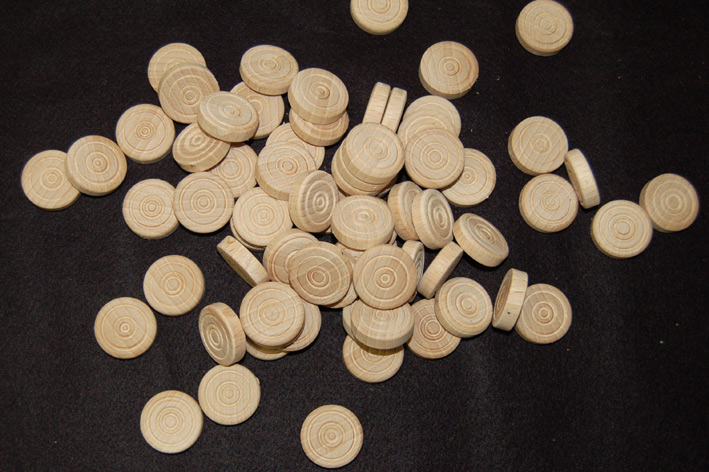
A heap of finished unpainted gaming counters.

Three unpainted gaming counters decorated with concentric rings. The edges are rounded.

Painting the gaming counters

The Libro de los Juegos of Alfonso X the Wise describes the colours of the four seasons for four-season chess and the tables game of the four seasons called the world:

'And because as we said above in the first season, spring, all things grow and men are refreshed and the trees and plants turn green the reason why air is its element is clearer than for any other season; therefore they made this season green. And the summer which is hotter and drier than the other seasons they made it like fire, which is of this nature. And therefore they made this season red for it element which also is. The autumn is dry and cold because its element is earth; it is more temperate than summer because it tends more toward cold than heat. The things that burn in summer, are born and refreshed in this season. And because its element is earth, its nature coldness and dryness therefore they made this season’s colour black. Winter they gave the element water which is cold and wet because in that season there are great cold, ice, snow, and rains. And because its element is water they made its colour white.'


Left: painting the black gaming pieces. One side can be painted at a time, a quarter of an hour later the other side can be painted. Right: various paints and the basic egg tempera in a glass. on the far right the finished red, black and purple pieces can be seen, as well as the box with unpainted tablemen.

I have painted the gaming pieces with egg tempera paint according to the recipe by Kathy Storm found on her blog Medieval arts and crafts. This consists of two parts of dry white wine and one part egg yolk. The pigments are added to this to form the tempera paint. Not all pigments used produced opaque paints (e.g. green and white), but adding more pigments decreased the ease of painting considerably. Therefore most gaming counters had several layers of paint. I used pigments of the Dutch paint mill "De Kat" that  presumably also were available during the Middle ages. These were:

  • red- summer - Venetian red
  • black - autumn - bone black
  • white - winter - double washed white chalk
  • green - spring - Italian green earth

The four colours for the game of the four seasons called the world.

I also painted gaming counters for an astronomical tables version for seven persons that is found as well in the book of games by Alfonso X. The counters for that game are:
  • red - Mars - Venetian red
  • black - Saturn - bone black
  • white - Moon - double washed white chalk
  • green - Jupiter - Italian green earth
  • yellow - Sun - yellow ochre
  • purple - Venus - mix of blue chalk, Venetian red and white chalk
  • many different colours - Mercury - black, red and yellow circles

The coloured gaming counters for the astronomical tables: black, yellow, red, purple, 
white, green and many different colours.
 
The completed Game of the Four Seasons, called the World as depicted in the Libro de los Juegos by Alfonso X, 
folio 89v.


I did have a wooden box for storing the counters, but eventually a box like the one shown below might be more appropriate ... The next post will continue with playing of the Game of the Four Seasons, called the World.


Painted wooden box for game pieces, dated ca. 1300 and made  in Germany. Sizes 7.9 x 26.4 x 9.2 cm.  
Metropolitan Museum of Art, New York, USA.

Wednesday, 10 October 2012

The game of the Four Seasons: making 7-sided dice


Medieval dice


Seven-sided dice, which are used for the Game of the Four Seasons, called the World are not common medieval dice. Common medieval dice are six-sided dice, just like ours. The book of Alfonso X the Wise describes how they are made, and how they should look like:

f. 84v: Showing the seven-sided dice.

"And we say that dice should consist of three squared shapes of six equal sides, all equal in size and perfectly square because otherwise they will not roll as often on one side as another and it would be trickery more than luck. And thus this is the first of the ways of cheating, as we will later tell17, in which those who wish to cheat make crooked dice.
And it is to have on each one of the six sides, pips in this manner: on the one side six, and on the other five, on the other four, on the other three, on the other two and on the other one, so that twenty-one pips come on each die, and so that sixty-three pips come on three dice.
And the pips should be placed in this manner: opposite the six-side, the one; and opposite the five, the two; and opposite the four, the three. And these dice can be made of wood, or of stone, or of bone, or of any metal, but especially are best the ones made of bone, the heaviest to be found, more than any other material and they fall more equally and more squarely on any type of surface."

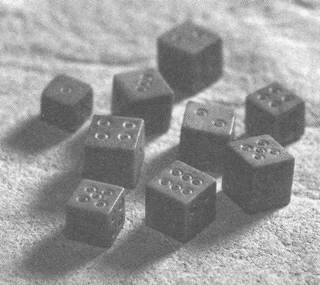
Indeed most unearthed medieval dice are made of bone, antler, jet, clay or wood. However, in medieval times the positioning of the pips could be different from Alfonso's description (or the from Roman or Modern times). The second system, only found during the Middle ages, was 1 opposite 2, 3 opposite 4 and 5 opposite 6 (instead of the opposite sides totalling 7). Medieval dice are small, compared to modern ones, sizes between 9-12 mm are common. False medieval dice also existed. A London find did contain a whole set of false dice. Some were weighted, or had more sixes or ones.


Left: Bone dice from Amersfoort, the Netherlands dating from the 14th century.  Right: Two systems of arranging pips from 12/13th century dice made of jet from York, UK. 11079 is our current system, while 11078 uses the alternative medieval system.


Two sets of Roman six-sided dice, currently on auction (14 October) at Hermann Historica (starting bid 3-400 Euro for 20 dice which are also perfect for medieval re-enactment). You can see the concentric circles of the pips, which are also very common during medieval times. Some have two concentric rings, other only one (left photo). The right photo shows some dice with sides that are rounded off and decorated. White dice are made of bone, the black of horn.

Seven-sided dice


There are several games in the "Libro de los Juegos" that make use of 7-sided dice, like Decimal chess, 4-season chess, and the game of the four seasons called the world. Folio 84 describes how the 7-sided dice are made. The book also describes an eight-sided dice, which looks like our modern one (used e.g. in fantasy roleplaying games).

"[f. 84]
And these dice are made like this: they have seven sides and the side with the highest number of pips is seven. They could not be made in another way for this game.
Because the shape of this die is uneven it falls edge up, with two sides showing. The side closest to the shooter is his. If they fall so that it cannot be determined which face to use, they are to be thrown until it can.

.....
There are other seven-sided dice than the ones we describe above. And this is how they are: they have two flat ends, the upper end with seven and the lower with six. The sides have five faces and because the sides are odd in number they cannot help but fall edge up. And for these five sides the play is the same as we described before. And this is their diagram and how they are made. [f. 84v]"

Making the seven-sided dice


I had some antler at home, which was at the basis solid white like bone. This made it very suitable for to make my 7-sided dice. Antler is worked similar like bone. First, I cut an 12.5 mm thick slice from the antler and ground it flat using sandpaper.


Left: The piece of antler, the two slices cut of (for two 7-sided dice) and two test 6-sided dice. Right. Sanding the slices of antler on a 150 grit sandpaper.

Then I glued a paper pattern of the pentagon on the antler slice with water-soluble glue. Then I used a hand held rotary tool (Dremel) with a ceramic cutter to cut the (remaining four) sides of the die. These sides were also sanded to have an acceptable die with equal squares. My first 7-sided die had squares of 12.5 mm, which made the pentagon side disproportionate large. My second die had rectangles of 11 by 12.5 mm, which gives a better proportion in comparison with the pentagon side.  


 Left: Laying out the pattern on the antler slice. Right: The roughly cut seven-side die.

The blank die being ready, the next step was to drill the pips. King Alfonso told that the 6 and the 7 were on the pentagon, but no mentioning was made for the arrangement of the 1 to 5 pips. I decided just to use the 1 to 5 order on the rectangles. The second problem was to drill the concentric circles for the pips. In medieval times this was done with a pump drill with some sort of toothed drill bit. I did not have these tools, so I had to improvise. For the concentric circle I used a sanding drum holder for my rotary hand tool and sharpened the edge. For the central dot, I used a cutter from the dentist (They use them only once and you can get them for free at your yearly visit). I also devised a jig to make the positioning of the dice under the drill stand easier (one-dimensional instead of two-dimensional), and another to hold the pentagon.


Left: The concentric ring drill bit made from a drum sander. Another drum sander is next to the pliers. Right: The bench clamp holding the the die moves along a fixed ridge, making the positioning of the drill easy and one-dimensional. First, all circles were drilled for this position, then the circle bit was changed for the dental cutter. After that, the ridge was moved to a new position to start again with some new pips.


Left: The bench clamp holding the jig for the pentagon. For the drilling of the rectangular sides, the die is just held in the clamp with some rubber protective edge. Right: Positioning of the die under the drill. First the concentric ring, then the centre dot.  


Left: A circular drawing by pencil is made on the pentagon, which is in turn dived into six parts. This shows the points where the pips should be drilled at equal distance. Right: The pentagon in the jig,  Pips can be drilled in sets of two, before the ridge has to be moved in a new position. This side will have seven pips, the middle three are finished, the two left pips only have the concentric circles. 


Left: The two seven-sided dice on the game board of the Four Seasons, called the World. Right: A close up of the dice.

f. 85v: A game of Decimal Chess using seven-point tables, seven-sided dice and seventeen pieces on each side. Alfonso is named as one of the players here.

The seven-sided dice throw reasonably fair, considering the fact that the pentagon sides are (slightly) larger. Next post will on making the game counters for the Game of the Four Seasons, called the World.