Wednesday, 24 September 2025

Medieval furniture from Dordtmund, part 2.

The Museum für Kunst und Kulturgeschichte in Dordtmund contains some more medieval furniture pieces, as well as some caskets. This post continues from the previous post (i.e. medieval furniture from the Museum für Kunst und Kulturgeschichte, part 1). Unfortunately, the museum website does not have an online collection, and only a few pieces can be found online.

The armoires

A small cupboard on horizontal feet (the socalled 'kufen') from Westphalen, Germany. Made from oak. The cupboard has two front doors and a lid that can be lifted, each with a fitted with a lock. The cupboard is dated around 1500.

(left) Front view of the horizontal legs (kufen). (right) Side view of the cupboard. The position of the hinge of the lid can be seen as well.

The openwork panels with decorative roundels are nailed onto a flat panel. Furthermore, the from planks of the cupboard are nailed to the sides. Some decorative ironwork and hinges provide further support.

Another view of the decorated top and the lid of the cupboard.

The 'kufen' are decorated with an animal head. Also note the lock and iron fittings.

Side and frontal view of the other kufen.

An armoire (Kredenzschrank) from Westphalen made from darkened oak. Dated around 1500, 
but due to the figurative panels probably first half of the sixteenth century.

Drawers with some mythical beasts.

The upper central door with a griffin.

The lower central door with a lion.

The sides of the armoire show linenfold panels.

The chests

In the background a small chest made from oak can be seen, with iron fittings and a handle, fastened with acorn-like nails. Dated 1350.

A chest from oak with iron fittings in the form of lilys. From the St. Maria church in Dordtmund. The construction of this chest has much similarity with Westphalian type of chests. Undated.

(left) The side view of the chest. (right) The top ironwork ending in some sort of lily-figure.


A frontal view of the chest.

The caskets

Casket 'Rosa' decorated with rosettes and stars. Dated after 1300. Made from apple wood . Measures 14,5 x 39 x 28.5 cm. According to the 'Red book' from the 14th century in the city archive,  this casket contained around 140 documents.

The reflection of the glass made taking photos of the casket quite a challenge.


Casket for documents made from pear wood. End of the 13th century. On the cover are the arms of the counties of Tecklenburg and Mark.


Painted casket from poplar with alternating the arms of the city of Dordmundt, the German Empire and local Saint Reinoldus. 10.7 x 37.7 x 20.5 cm. Dated 1300.


Saturday, 24 May 2025

A visit to Dordtmund: medieval furniture from the Museum für Kunst und Kulturgeschichte, part 1

 
Detail from the "Entkleidung Christi" showing a man using an auger. 
                                                               Egg tempera on oak, around 1480. Painted by someone around the Master of Liesborn.

The "Christmas market" shopping trip of last year went to the German city of Dordtmund. I took the opportunity to visit the Museum für Kunst und Kulturgeschichte, while the others were immersing themselves in glühwein and buying Christmas presents. The museum has a nice collection of medieval (and later) furniture, including a small strycsitten. I was able to make some rough measurements of the strycsitten, and of course took a lot of photos (without flash).

The Dordtmund strycsitten 

The Dordtmund strycsitten is not completely original anymore. Several pieces have been replaced - or are missing - for instance, the horizontal bottom rail at the back. I could make some rough measurements using my tape measure trying not to touch the actual item or standing on the display floor (the guardian was watching my back). The strycsitten has a width of 90 cm, wide enough to squeeze in two persons. It has a depth of around 49 cm and a height of around 88 cm. Seating height is around 43 cm. The strycsitten is of German origin and dated to 1400. It is made from oak. The information panel also mentions that traces of paint have been found on the oak.

The front side of the Dordtmund strycsitten. The horizontal board below the seating is a replacement.

Bottom and top of the swinging backrest. The actual swinging pin is located (and hidden) at the seating. 
The swinging pin is also not visible from the outside.

Three pins are used to secure the replacement front board.

The left and right armrests. Note that the top of the backrest has an angle.

This shows nicely the construction of the swinging arm. (On the wall an image of a quite different strycsitten is shown)

The sides consist of two panels decorated with a diamond grid with carved roses.

The bottom decoration on the side of the strycsitten.

The frame is decorated with twisted spiral columns (Left), at the top on which an animal figure (bear?) resides (Right). The spiral column on the right side of the struycsitten are largely detoriated.

The other side, unfortunately a bit unclear photo, but it shows a similar layout.


Writing desk


The view on the writing desk is a bit obscured by the iron strongbox in front of it. The writing desk consist of a small cupboard with a door, a movable writing plateau set at an angle, and a top shelf.
 
The panels in the frameword show intricate linenfold patterns. 

The top (left) and bottom (right) panels have different linenfold patterns.

The lock of the writing desk.

The hinge moves from outside on the door to inside on the frame. Note the iron nail that secures the inside part of the hinge.

The writing plateau is connected with two small hinges to the top shelf.

Triangular turned chairs

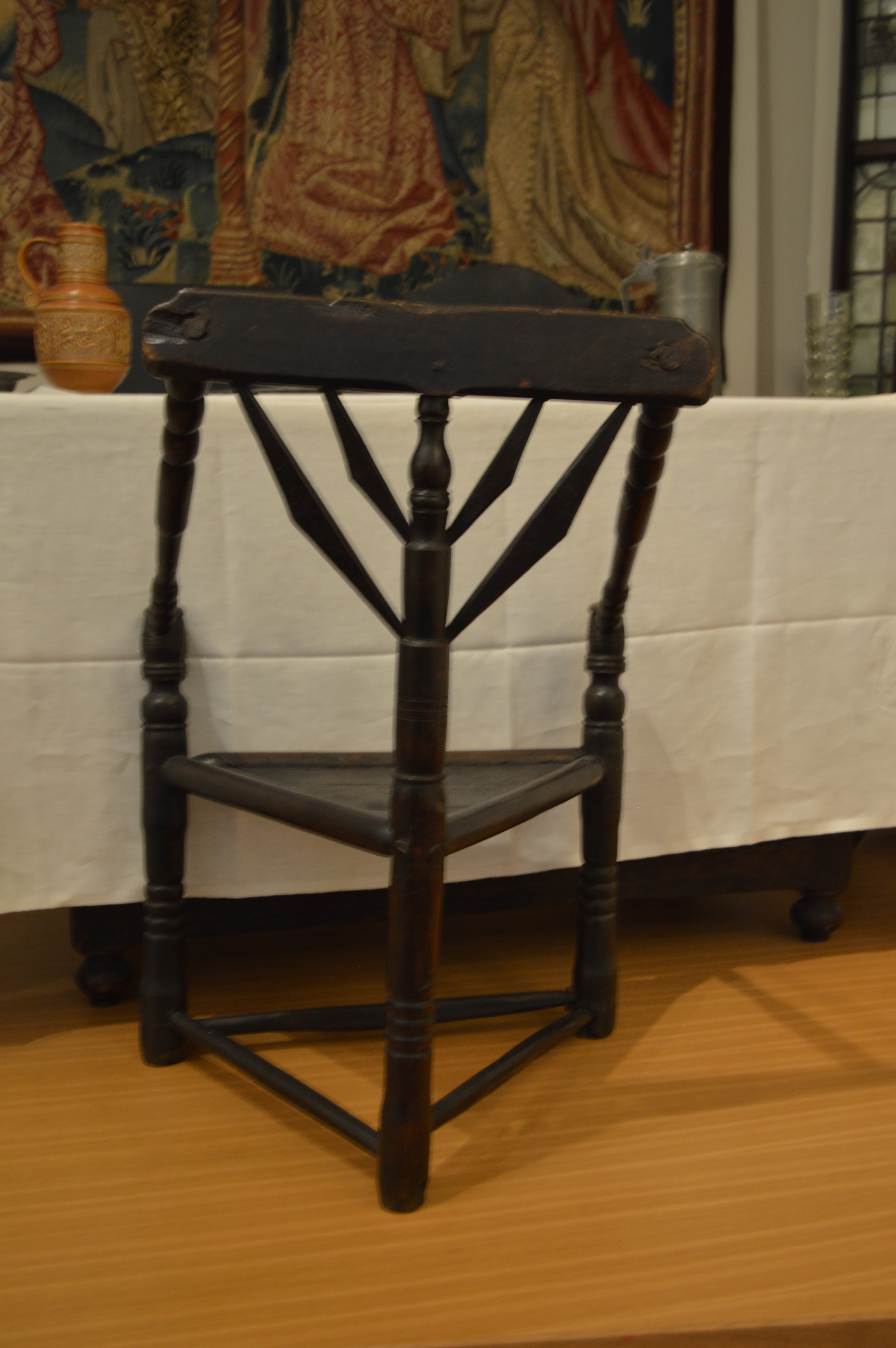
Triangular turned chairs are a common type of seating found from the late medieval period up to the 18th century. The construction of these chairs remained the same during this period. The Dordtmund museum has several turned triangular chairs on display, however they date from the 17th and 18th century. Fortunately they have some missing parts, thereby revealing some construction details of these chairs. This type is also called 'Ammenstuhl'.

The side view of the triangular turned chair

Back view of the chair.

This photo shows how the parts of the backrest are connected. The armrest goes through the board of the backrest. The four V-shaped supports end up in mortises in the backrest board and the vertikal stile. The vertikal stile is fixed with a wooden pin to the backrest.

A view of the underside of the backrest. The armrest goes through the backrest and is fixed with a small pin from the underside.

The horizontal rails for the seating are all set at the same height ...

...whereas the horzontal rails of the bottom are all set on different heights.

The underside of the seating. The seating board consists of three planks. The (one) horizontal rail goes through the vertical stile.

The top of the seating. This horizontal rail does not completely go through the stile(s), but stops somewhere halfway and is then fixed with a pin (can be seen left and right). The armrest goes through the lower stile and is fixed with a pin.

Sort of top view of the triangular turned chair. My Samsung S9 (~15 cm) was added for size comparison.

Sort of back view of the triangular turned chair. My Samsung S9 (~15 cm) was again added for size comparison.

This 18th century chair has a gap near the stile, and nicely shows the groove and how the horizontal rails go into the stile.

A second 18th century chair is missing some part of the seating board and more clearly shows the groove.

Friday, 28 February 2025

White ravioli

It has been a while since I have written anything about a medieval food recipe. Last year, we were re-enacting at the (pre-)historic village in Eindhoven which also involves cooking a meal for the Saturday. This time I tried out some new medieval recipies. One of them was white ravioli, a sweet dish.

White ravioli does not look nor taste like the modern ravioli.

Piglia de bona probatura fresca he pistala molto bene poi azonze pistando un pocho de butiro, zenzevero he canella. Et per una probaturaazonze tre ghiari d'ova ben batuta et del zucaro honestamente. Et incorpora tuti queste cose insieme. Poi fa li ravioli longhi he grossi uno dito. Poi imbratelli in bona farina. Et nota che questi volemo esser senza pasta. [marginal annotation in the manuscript: et se cum pasta li vorrai, falli.] He falli bollire adasio che non si rompano. Como hano levato uno buglore levali fora he meteli in scutelle cum zucaro, canella, he li poi far ghialdi de zaffrano.

Manuscript MS Bühler 19, Pierpont Morgan Library, New York, USA, 5rv.

Of course I cannot read medieval Italian (or Napolitan as the book is believed to be of Napolitan origin), but luckily there is an English translation in the book: The medieval kitchen - recipes from France and Italy by Odile Redon, Francoise Sabban and Silvano Serventi. There is also a youtube video (Italian with English subtitles, see below) of the recipe, though this does not mention the source, just that it is late 15th century.


Ingredients

600 g soft white cheese, such as mozarella (di buffola)

20 g of butter at room temperature

2 egg whites lightly beaten

4 tablespoons of (cane) sugar

flour for dredging

1/2 teaspoon of ground ginger

1 teaspoon of ground Ceylon cinnamon

salt

a few threads of saffron (optional, I did not use it)


Preparing the dish

Mash together the cheese, butter, ginger, half of the cinnamon, all sugar except 2 spoonfulls, a pinch of salt and the saffran in a mortar or food processor. When the mixture is very smooth (or a bit less smooth in my case) add the egg whites. Cool down the mixture.

Mix together the remaining sugar and cinnamon.  Put some flour in a  shallow plate for dredging.

Bring a pan of water to the boil, and lower it to a simmer.

Take a spoonfull of the mixture and form the ravioli. Coat it with flour by rolling it through the shallow plate. Set aside on a floured tray or cookie sheet.

Drop the ravioli one by one in the lightly boiling water. Do not stir the ravioli as they can break apart easily. When the ravioli are ready they float to the surface and they can be scooped out with a skimmer. Drain well. Serve with some sprinkled cinnamon and sugar mixture.


The white ravioli served us warm as a desert (the ravioli were served as a first course though at a banquet by Sozzo Bandinelli on 23 December 1326 for the knighting of his son) at the end of our dinner, and the leftovers cold as breakfast the next morning. They both - warm and cold - tasted delicious.


Thursday, 13 February 2025

Tresoor of castle hernen Part 11: The tresoor at the castle


On 18 September 2022 the finished tresoor officially moved to its final place in castle Hernen to be revealed to the general public.
 

But first ...

Whereas the tresoor was ready, there was still one thing to be added to it: our signature. We did not want it to be easily seen, but it should be visible without moving the tresoor. So the backside was not an option, and of course all the front parts as well. We decided on the frame, underneath the lower plateau of the tresoor. on your knees, using a lamp from your mobile phone you would be able to spot 'St. Thomasgilde MMXXII' written (or burned) with a pyrographic pen. 

Our signature on the tresoor.

To the castle ...

The tresoor just fitted into our car, so the travel to the castle proved to be no problem. This time we drove our car into the small courtyard, so that we had a smaller distance to carry. Hoisting the tresoor on the stairs and moving it to the kemenade was a bit more work. We first thought the tresoor would fit well againt the (otherside of the) wall of the main hall, but it appeared a bit lonely there. We then moved it to its current place on the opposite wall, next to a large window and a candle stand.


The tresoor is now fully integrated in the tour of the castle. It is especially satisfying that visiting schoolchildren with a visual handicap also had much fun with the tresoor, as they could feel the carving of the knight and the dragon, and the working of the lock.

Providing the curator of the Stichting Gelders Landschap en Kastelen with the key of the tresoor.

 Bram and Marijn telling the secret story of the Tresoor of Castle Hernen: of how Reyner van Wijhe was tricked by the St. Thomasguild to be a member of the pro-Guelders faction (see blogpost 6 of the tresoor).


Two photos of the tresoor at the incorrect spot in the kemenade of castle Hernen.