Saturday, 15 May 2021

Pilgrimage 21


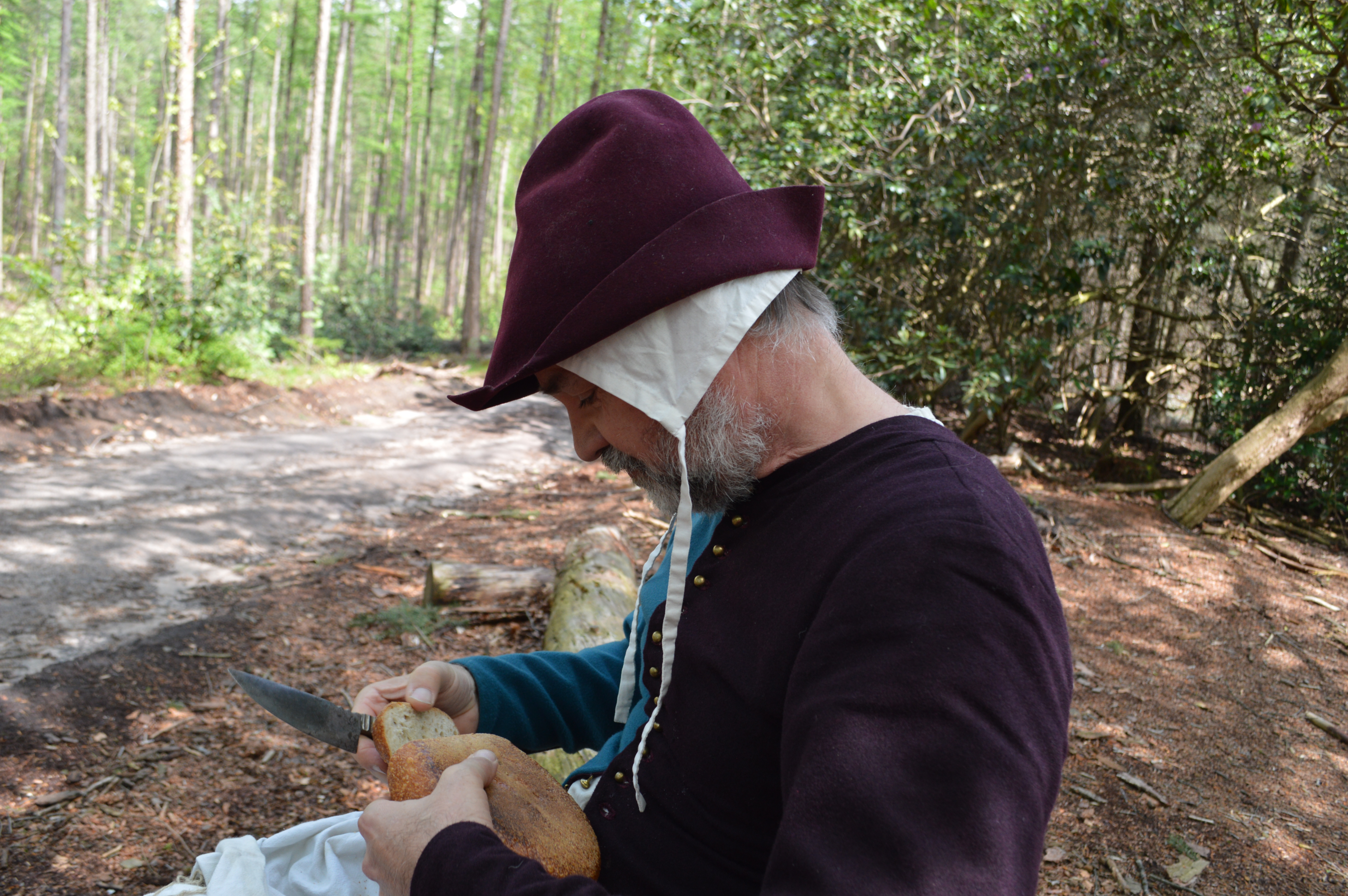
We read about the project Pilgrimage21 of the Company of Saint George, the famous Swiss 15th century re-enactment group and thought this would be a marvellous idea to do some medieval re-enactment during corona times. Worldwide medieval re-enactment groups were encouraged to go on pilgrimage journeys to their local/nearby pilgrimage shrines on the feast of Saint Corona (14 May) and the weekend afterwards (15 and 16 May 2021). Photos and Videos of the preparation and the actual pilgrimage were to be shared on Facebook (CoStG: project Pilgrimage21) and Instagram (#Pilgrimage21).

Saint Corona

St. Corona happened to be a useful saint for the woodworkers as well, being the patron for lumberjacks (as well as with causes involving money, like gambling and treasure hunting). It happened that the lady Corona was martyred because she comforted (Saint) Victor, a Roman soldier who was tortured and killed for his faith. According to the passio of Corona, Corona was bound to two bent palm trees and torn apart as the trunks were released. This supposedly happened around 180 AD, but there is no clear consensus on the date. Around 1000 AD Otto III, Holy Roman Emperor brought Corona's relics to Aachen in western Germany. Her relics were rediscovered during excavation work at Aachen Cathedral in 1910. The relics were removed from a crypt and placed in a shrine inside the cathedral.


Illuminated miniature of the martyrdom of Saints Victor and Corona, on a full leaf from a Book of Hours, France (Paris), c. 1480.


Maria of Redichem

We were lucky to have several medieval pilgrimage places nearby: Saint Cunera in Rhenen and Maria of Redichem in Renkum, and somewhat further away the Chapel of Saint Walrick (with the koortsboom)  in Overasselt. We decided to go to the church of Maria in Renkun, as the pilgrimage route is the most beautiful to walk - not much asphalt roads - and conviently was the closest and shortest route. Furthermore, the church is open every day from 9 am to 4 pm, and has a nice rosegarden with a walk along displayed icons.


 The statue of Maria of Redichem, dated 1350.

Redichem (or Renkum) is a pilgrims place since 1380 thanks to the statue of Maria in a chapel to which miracle cures were attributed to. The French king Charles VI donated two relics to the chapel: a splinter from the True Cross and a thorn from the Crown of Christ. The chapel also played an important role in the life of Maria of Guelders (Marie d'Harcourt), wife of duke Reinald IV of Guelders. In 1405 she founded a convent for the sisters of Modern Devotion at the place of the chapel. The duke ordered one of the brooks (Molenbeek) to be redirected so the nuns would have a fresh water supply. Maria of Guelders frequently visited the place, for instance in 1407 together with several French courtiers.

In 1585 the convent was destroyed, but some nuns were able to keep the statue of Maria into safety. Then the statue changed hands regularly, until one collector returned it to Renkum in 1928. Now it can be found in the 'Our Lady of the Assumption' church. An embroidered cushion from 1390 that used to reside in the convent is now in the depot of the museum Catherijneconvent in Utrecht. The cushion depicts the Dedication in the temple (Luc.2:22-39).

With silk embroidered linen cushion from the Redichem convent. ABM t2060 Catherijne convent, Utrecht. 57.0 by 71 cm. These cushions were used to place (religious) books upon.


Thomasguild's Pilgrimage21 to Maria of Redichem


Detail of the Pilgrimage21 Map with Maria of Redichem indicated by the arrow.


The end of the Pilgrimage at the Church of Our Lady of the Assumption in Renkum. 

Monday, 19 April 2021

Some more engravings of late medieval Tiroler furniture

In this post I would like to show some more furniture pieces from the plates in the books 'Die Zimmergotik in Deutsch Tirol' by Franz Paukert. As previously mentioned, due to my scanner size limit each plate consists of two scans that are 'glued' together.


The bench (with turnable backrest) and the chest, two works of Tyrolean joinery that are already being sought out of the country, are shown with the use of  dimensional sketches and photographs made available to the publisher by Mr. Ueberbacher from Bolzano, Italy.

Canopy bed from the Castello Principesco, or Landfurstliche Burg, Merano, Italy.


These two folding chairs are in the Figdor collection in Vienna. One of them (Figure A), coming from Bozen, shows the old, quilted leather seat belt and its shape is reminiscent of the faldistorium of the women's monastery on the Nonnberg near Salzburg. The armchair of Figure B, like the previous one, has crossed legs but with partially suspected monkey- and crab-like knobs and comes from St. Michael in Eppau. (The Figdor collection was auctioned in the early 20th century; the auction catalogues can still be found in second hand book stores)


On the other hand, the design of this cabinet does not differ insignificantly from the usual furniture shapes. The straight end of the upper frieze, the framing of the door wing and the somewhat clumsy ornamentation characterize the piece as a late form of medieval art. 

Cabinet in the possession of  Mr. J. Strasser in Merano. In terms of its origin, this piece of furniture is one of the few surviving pieces of its kind. A real Tyrolean work and despite its relatively later origins unaffected by the imitation of architectural details that are so popular elsewhere, it is evidence of the fact that the Tyrolean carpentry did not tend to indulge in miniature replicas of the facade construction, but rather focused on healthy construction, and flat cuts, engraving, tracery carved into the wooden base and moderate painting are the only means to which this cabinet owes its very handsome appearance. The upper and lower parts of the cabinet are firmly connected, and the sides are completely smooth. Metal bars never seem to have been there at the door. Merano, Italy.


Noteworthy is the simplest possible treatment of the tracery fillings in the wash basin: flat cuts with a coloured background, as well as the extremely simple construction of the box, which is common to almost all of this type of Tyrolean Gothic furniture; Jointed boxes with decorative strips placed in front of them on jointed feet and finally the almost continuous painting of the ornaments or at least the flat base of the carved parts. Castello Principesco, or Landfurstliche Burg, Merano, Italy. 


A chest owned by the bookstore owner F. Plant in Merano. In spite of its extremely simple structure and in spite of its decoration reminiscent of the Romanesque period, it was found to be of a rather late origin and proof that the Tyrolean gothic art did not reluctantly fall back on very early roots. The lid of the cest is not connected to the other part of the chest by iron hinges, but by wooden pegs which function as axes of rotation, and go through the lateral gripping strips and the sides of the chest.

Among the increase in the number of furniture pieces of the Landfurstliche Burg in Merano over the last few years, the furniture shown in whole or in part on the plates above and below is the most important. The legs of the chests belong to the box, which differs little from the already known pieces of a similar kind and only in the ornaments and the exposition of the fields on the front.


Monday, 5 April 2021

A late medieval woodwork book


Recently I bought an antique set of seven 'books' on 'Die Zimmergotik in Deutsch Tirol [late medieval woodwork in Tirol] by Franz Paukert. They were published between 1890 to 1903 and contain many superb engravings on the late medieval woodwork and furniture from Italian and Austrian Tirol. Each of the books contain 32 engraved plates of around A3 size and a similar sized booklet of a few pages containing the descriptions. The engravings are printed in a reddish-brown colour, black, and even some are printed in green ink. My set of books is not complete, a few plates are missing, and some others are damaged, but this caused the lot to be at an affordable price. What makes this book so interesting is that the engravings are very detailed, some engravings focus even on details of the construction. Furthermore, the engravings show a rule, so you actually have the dimensions of the woodwork.


 The seven books contain 32 loose printed engravings and a thin booklet with the descriptions.

Though many plates show furniture pieces, most of the plates concern other carved woodwork, like doors, wooden panelling, ceilings, etc. Also the ironwork on the woodwork is focussed on several plates: hinges, locks, door knockers. Also a few designs of medieval wall drawings are shown. To give you an idea of the furniture included in the book, some of the plates are given below with their original (translated) comments.  As my scanner has an A4 limit, each plate consists of two scans are 'glued' together.


Folding chairs from Campan Castle (Bressanone, Italy) and Bolzano (Italy). Movable gothic seating has hardly come across us in Tyrol. The depicted examples present a form that has hardly been used at least in the German part of the country. Its form has been borrowed from the late Gothic stock of Italian decorative art. Both armchairs are made of beech wood and almost only differ from one another in the cross-section of the ribs.

Despite the extremely heavy shapes, this object is not uninteresting because of its structure. The basic ornaments of the crenellated canopy are very lively in the drawing and emphasized in colour. Burg Reifenstein, Campo di Trens, Italy.

The whole lattice, consisting of four rectangular parts with a common pointed arch, is mainly formed of openwork tracery. The fillings are red, yellow or blue, while the carved frames are painted green. Burg Reifenstein, Campo di Trens, Italy.

Tratzberg also conveyed a gothic light woman - a unique item for this country - to the present. The engravings reproduce the colour-coded model in front and side views to such an extent that the composition clearly can be recognized. Schloss Tratzberg, Jenbach, Austria.

In this piece we encounter a very attractive achievement of gothic small art. The wood of the stone pine, which is used almost everywhere in Tyrol, served as material for the work. The background of the freely treated ornaments as well as that underlaid with the tracery fillings is blue. All of the rods of the epiglottis resemble cords made of dark and light wires. It's just a shame that the work suffered more than it gained from a restoration that was carried out decades ago. A newer, much too low base and completely nonsensical, admittedly neglected elements on the crenellated wreath today spoil the impression of the whole cabinet.

Chair from Tirol castle near Merano (Italy). In his art history of Tyrol and Vorarlberg, Atz describes this piece of furniture as one of the oldest chairs in the country. At present, the chair shown has a praying desk in front, which, on closer inspection, reveals itself to be a new addition. The ornament on the rear wall of the chair is engraved, the decoration on the crown is flat-cut. The two side walls show different contours. The only thing to note about the construction of the furniture, which can be seen in full from the drawing, is that the seat can be uplifted.

The table comes from Burgeis in the upper Vintschgau and has only recently been found in the collection of the Merano Museum Association, along with several wood carvings and carpentry work of religious origin. It is well preserved and only supplemented in some places. 

Chest from the collection of the antiquarian Alois Ueberbacher in Bolzano, Italy. The chest is of particular interest, taken from the daily changing material of its owner: the one due to the charm of the varied decoration, this one due to the way the tracery is treated. 

Of what the Fugger room holds in the form of movable household items, one is easily identified as a cabinet holding a wash basin.Schloss Trazberg, Jenbach, Austria.

Sunday, 14 February 2021

Meddling with madder - part 2

 The results of the dilution test after 24 hours in the madder solution.

With the first experiment on colouring antler with madder done, the basic recipe was elucidated. The next step was to determine which strength of solution led to which red colour strength. To do this a set dilutions was made. So, to recapitulate, the basic recipe was:

  • Pre-soaking antler for 1 hour in water
  • Make madder solution with 4 gram sodium in 400 ml water (a 1% solution) + 5% WOF madder extract for 1 hour at 60 degrees Celsius
  • Antler for 2 hours in madder solution at 60 degrees Celsius
  • Cool down for 24 hours in madder solution
  • Rinse with cold water

Dilution test

For the dilution test a set of five different solutions was made. The basic madder solution was diluted with a 60 degrees Celcius 1% sodium solution in 5 different glass jars:

  • 100%  = 200 ml basic madder solution
  • 50%  = 100 ml basic madder solution + 100 ml sodium solution
  • 30%  = 60 ml basic madder solution + 140 ml sodium solution
  • 20%  = 40 ml basic madder solution + 160 ml sodium solution
  • 10%  = 20 ml basic madder solution + 180 ml sodium solution

The results of the dilution test directly after 2 hours at 60 degrees C. The (quarter) antler pieces are at the back, while the elongated bone pieces are at the front.

As I also had some (cow) bone pieces leftover from making soup, these were added as well to the test. The antler and bone responded differently to the dilution test. The bone produced a much lighter shade of red than the antler. This could be due to the fact that the bone was still 'fatty', and thus less able to absorb the madder. Or it might be that (cow) bone is less able to absorb the madder than antler. The 50% solution looked most agreeable to me, having a full red colour and not being too dark red. This solution was chosen for the production of the coloured tablemen.

Finalisation

The results of the actual colouring of the tablemen were not as straightforward as thought. The coloured antler game pieces had different shades of red, giving it a spotted appearance. Also, a wet solution brings out the fibres (just like wood), giving the game piece a slightly rough texture. Especially, the porous inside of the antler produces the most 'rough' texture and needs sanding to make it smooth again. The first game piece was sanded to much, and blank bits appeared. Therefore, I repeated the colouring procedure on the same game pieces in order to darken and recolour the light coloured spots. The result was that the game pieces were now a dark red colour.

 
 When you saw the test pieces in half you can see that the madder colour consists only of a small layer on the bone and antler. only on the porous part it invades further into the tissue.
 
 
The wet tablemen showing a spotty colouring.

When the tablemen were dry, the porous parts were carefully sanded with a 320 grid sanding paper, after which the complete gaming piece was polished with a cotton polishing wheel. Afterwards the piece was oiled with walnut oil, just as it was described in the 12th century treatise by Theophilus. 

 
The 100% and 50% madder solution test pieces with walnut oil.
 
 
Some of the madder coloured and uncoloured antler tablemen after the walnut oil finish.

Friday, 11 December 2020

Meddling with madder - part 1

I have been quite intrigued by the red coloured medieval tablemen that are found in the different museum collections around the world (for instance the Metropolitan Museum of Art, the Victoria and Albert Museum, the Museum für Angewandte Kunst Köln, among others). How were these pieces coloured and is this easy to reproduce? The how was easily answered, as the monk Theophilus provides a recipe in his book 'On divers arts' which was written around 1122 - a similar date as most of the red game pieces, which were manufactured in workshops in Cologne, Germany.


A game piece with Samson slaying the Philistines with the jawbone of an ass. Madder coloured walrus ivory. 6.3 by 1.3 cm. Made in Germany around 1140-1150. Photo Metropolitan Museum of Art, Cloisters, New York, NY, USA.
 
Theophilus writes in Chapter 94 of his book:

'There is also a plant called madder, whose root is long, thin, and reddish. After it is dug up, it is dried in the sun and pounded in a mortar with a ball. Then lye is poured over it and it is cooked in a raw pot. When it has boiled well, if the bone of an elephant or a fish or a stag is put in it, it will become red. from these bones or horns knops can also be made on the lathe for the staves of bishops and smaller knops for various useful objects. When you have turned these with sharp tools, smooth them with shavegrass. Collect the shavings on a linen cloth and, still turning the lathe, rub them vigourously on the knops which will then become completely shining. You can also polish horn-handles, huntsmen's horns, and [horn] windows in lanterns with sifted ashes on a woolen cloth. But do not forget to smear them finally with walnut oil.'

Of course the bone of an elephant is ivory, the bone of a fish relate to normal animal bone, and the bone of a stag is antler. I am unsure if Theophilus also means that (cow, goat) horns can be stained, as these have a quite different structure more similar to nails and hairs. However, wool for medieval clothing is commonly stained with madder. There is evidence that madder was already cultivated for this purpose in the Netherlands in the 12th century; in later centuries the Dutch madder became famous for its quality.


A similar uncoloured game piece with Hercules throwing Diomedes to his man-eating horses. Elephant ivory. Made in Cologne, Germany around 1150. Diameter 7 by 2 cm. Photo Metropolitan Museum of Art, Cloisters, New York, NY, USA.

As I was making a set of alquerque game pieces from antler, I wanted to make one set coloured red. The recipe of Theophilus was not very specific. In fact it looked more like a medieval cooking recipe without amounts. Searching on internet did show many recipes for colouring with madder, but these all concerned wool or cotton, and all are different as regards to amounts of the ingredients. 
 
A mordant - alum - is needed to fix the red colour to wool. The wool is first treated with the mordant, and then to the colouring solution. For cotton and hemp, both non-animal (plant) fabrics, an extra pretreatment is necessary before the alum. On the other hand Theophilus, as well as the early 18th century scientists do not mention alum at all for bone colouring. 

There are also other steps in the colouring process that need to be considered: temperature influences the colour; a temperature above 82 degrees Celcius turns the red colour into brown (for wool). Hard water (basic pH) increases the intensity of the red colour. The time in the colour solution and the strength of the colour solution influence the outcome as well: the longer, the darker, and more pigments in the solution also make the end result a darker red.

So what is the best way to colour antler madder red? I decided to do some tests to find out.

The first test

Madder powder as well as madder extract was bought from paint mill 'De Kat' in the Netherlands. Madder extract has already the red pigments (alizarin and purpurin) from the root extracted, and is sold as a plaque of dried crystals, which needs to be dissolved again. The madder powder is finely ground madder root, from which the madder pigments still need to be extracted before colouring the antler (or wool). I also purchased some alum from 'De Kat'.

As a basis I used 'the Maiwa guide to natural dyes - what they are and how to use them'. This free pdf guide (provided by the Maiwa company which also sells these pigments) provides a very clear description on colouring for each dye and as well as for mordanting. 
 
Left: The two basic madder preparations from powder and extract in the 60 degrees Celcius water bath. Right: the setup in the kitchen with the meat thermometer at 60 degrees.

 
The amount of dyestuff needed is based on a percentage of the weight of fibre (WOF), in my case the weight of the antler pieces. For madder powder this is 35-100% WOF, for madder extract this is 3-8% WOF. The antler pieces should be just fully immersed in the solution. So the actual amount of water does not matter, the amount of pigment that is available to the fibre does. I used 50% WOF for the powder and 4% WOF of extract.

Left: Pretreated antler pieces: with water in the glass, or with alum in the plastic box. Right: Four smaller test pots in the 60 degrees Celcius water bath.
 
Half of the antler test pieces were pretreated with alum, 15% WOF (as for wool). The other half was only immersed in water. During mordanting, the solution with the antler pieces was kept around 60 degrees Celcius for one hour. The pots with the solution were heated au-bain-marie (a waterbath) in a pan on a low flame and the temperature was kept in check using a digital meat-thermometer. If the temperature started to rise, a bit of cold water was added to the pan. After one hour, the pots were left to cool.

I made 400 ml of each madder solution. The pots with the madder solution were placed at 60 degrees Celcius for one hour in the waterbath, as described above. During the hour the colour of the powdered solution darkened, the extract solution was quickly dissolved and had a similar dark red colour.
 
Then the pretreated antler pieces were divided over smaller pots and the colouring solutions added. To the pots with antler pieces without alum an extra 2 gram of household sodium was added to each madder solution. The sodium carbonate was used to raise the pH of the solution to see if this influences the intensity of the colour. The test consisted of five pots:
  • Antler mordanted with alum, madder powder solution, with sodium added during cool-down
  • Antler mordanted with alum, madder powder solution, no sodium
  • Antler mordanted with alum, madder extract solution, with sodium
  • Antler with water, madder powder solution, no sodium
  • Antler with water, madder extract solution, with sodium

The pots were kept around 60 degrees Celcius in a waterbath for 2 hours, after which they were left to cool down for 24 hours. Then the antler pieces were rinsed with cold water and dried.


Colour after 2 h 60 C degrees bath. The darker red coloured pieces on the right are without alum  pretreatment and with sodium.


The colour after 24 h cool down with the same oder of test pieces. The piece on the far left (powder + S + alum) was treated with sodium during the cool-down period and gained in colour strength.

As it turned out, mordanting with alum did have no positive effect on the colouring process for antler. Sodium, on the other hand, did. All antler pieces in a solution containing sodium were dark red, the one with sodium added later medium red, while those without were only lightly red coloured. Both the madder extract and the madder powder did colour equally well. Madder powder is cheaper than madder extract, but madder extract is a clearer solution and does not have the risk of the powder grains to become affixed to the antler. So the extract was used for further experimentation (in the next blogpost).

A side note

 
Science also had an early interest in colouring bones red. The first scientific study on the effects of madder on bones is from the early 18 century by M. Du Hamel du Monceau and published in the Philosophical Transactions of the Royal Society of London. An observation from a surgeon eating a pig with red bones, led to experiments where pure ground madder was (forcibly) fed to chickens, which died after a few days. Indeed, the chicken bones had become all red, but not the feathers.
 
 
Nowadays the synthetic red pigment (alizarin) that is also found in madder is still used to study the growth of bones and their calcium deposits.

Diaphonisated Smooth newt (Triturus vulgaris). Short-term xylene treatment. Cartilage area (white arrows), ossified structures (black arrows). Bar = 5 mm.
Smooth newt (Triturus vulgaris) with bone coloured with alizarin. Bar = 5 mm.

Sources

  • G.C.H. Derksen (2001) Red, redder, madder. Analysis and isolation of anthraquinones from madder roots (Rubia tinctorum). PhD thesis, Wageningen University, Wageningen the Netherlands. https://edepot.wur.nl/197629.
  • M. Du Hamel du Monceau (1739) Observations and experiments with madder-root, which has the faculty of tinging the bones of living animals of a red colour, by M. Du Hamel du Monceau, F.R.S. & c. Communicated in a letter to Sir Hans Sloane, Bart. Pr. R.S. Translated from the French by T.S. M.D.F.R.S. The Royal Society of London Philosophical Transactions Vol. 41, pp. 390-406. https://www.jstor.org/stable/104301
  • Antje Kluge-Pinsker  (1991) Schach und Trictrac. Zeugnisse mittelalterlicher Spielfreunde in salischer Zeit. Jan Thorbecke, Germany.
  • Vivian B. Mann (1977) Romanesque ivory tablemen. PhD thesis, New York University, New York, USA.
  • Theophilus (1122) On diverse arts. Translated by J.G. Hawthorne and C.S. Smith (1979) Dover Publishing, Garden City, NY, USA.
  • The Maiwa guide to natural dyes - what they are and how to use them. https://naturaldyes.ca/instructions