
An image of a turned medieval chair on Pinterest connected me to the Norwegian site UNIMUS. This is a portal of six Norwegian University Museums containing their huge collection of high quality photos of objects and research activities. When you type in 'Middelalder' (= Middle ages), 20553 photos are found. It took some long evenings to sift through all these photos and save the interesting pieces of medieval furniture, tools and games. Most of the 'Middelalder' photos (I guess over 80%) concerned images of archaeological dig sites - not really interesting. Another large quantity concerned runic inscriptions on wooden sticks, also not so interesting for me. Already in my previous post, a few photos of medieval planes from originating from this portal were shown. Here I would like to show you the Norwegian medieval chairs and benches from this site. It will save you going through all these photos yourself, although I have shrunk the photos in size (originally they were 2-3 Mb each). Although these photos show nice pieces of furniture, almost no information on the furniture piece is given on the UNIMUS site. It took some more nights to gather some additional information of these seats. I will show other pieces of Norwegian furniture in a following post.

The turned chair from Urnes Stavkirke that started it all, dating around 1200.
Most of the Norwegian medieval furniture is early medieval in style (1100-1300) and still has influences of the Viking period, visible in the decoration style.


Box chair dated to the early 13th century from Blakar farm in Gudbrandsdalen. The staves are made from birch while the panels are from pine. Part of the seat makes up the lid for the box with wooden hinges protruding on both sides, while a hole in the front seem to be from a missing lock.


The Tyldal chair (1150–1200) made from birch originating from Osterdalen, Hedmark.


Chair from Gålås, Ringsaker, Hedmark with carved animal heads. The backrest is 13th century, the front a 18th century restoration. Note that the chair legs are uneven.


A bishop's chair from Heddal stavkirke dating from the 13th century. Kulturhistorisk museum Oslo.

A (part of a) pine choir stall with Mickey Mouse ears from Hol stavkirke, Hallingdal, dating from the late 13th century. Kulturhistorisk museum, Oslo.


Choir stall with ears from Skrautvål, Nord-Aurdal. 13th or 14th century.
Most of the two-seat benches below seem to be some kind of bridal chairs.


A bench for two persons from the Kulturhistorisk museum, Oslo.


Another church bench from the Kulturhistorisk museum in Oslo originating from Eastern Gausdal, Oppland.
The backside of the backrest of the bench is much more decorated than the front.


A bridal (marriage) pine bench dating from 1517 originating from Nes Church, Nes in Telemark. Length 120 cm, height 118 cm, depth 38.5 cm. The backrest consists of two wide board, and the seat and the front of one. The sides are carved at the top as a fan ending in four circles. Bridal bench is now painted over, probably in the 1700s. The rear of the backrest has sloppily painted yellow-pink vines and foliage with light blue middle swath. Profiles along the edges are blue. Backrest cover is decorated with a newly wed couple, dressed in village costumes. Around them is a text in black letters from of Ruth, I, v. 17. The stylized foliage is painted red.

A simple bench originating from Telemark.
 A simple bench or stool from Torpe Church in Hallingdal.
Length 1.08 m and depth 0.26 m. In the middle of the seat is a small ornamentation.

 Back of a bridal bench from the Kravik farm, Buskerud. Made from pine, 70 by 41 cm. Decoration shows two fantastic animal figures (griffins?); below them are three dragons that seem to join in the battle. The rest of the chair was rotten away by humidity.

Length 1.08 m and depth 0.26 m. In the middle of the seat is a small ornamentation.

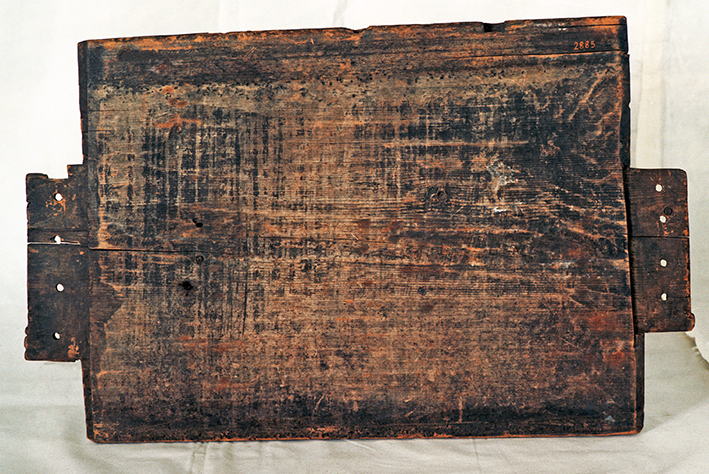


A bench from Heddal stavkirke, Telemark.


A bench from Rennebu, Sør-Trøndelag.


Side pieces of a bench from Hemsedal church. Height 1.35 m.


A side plank of a bench from Torpe church in Nubgaarden. Only one side is decorated. Height 140 cm, width 43 cm.

Church bench from Heddal stavkirke, Telemark, Notodden.


A choir bench (cathedra) from Verne's Church in Stjørdalen.
One side piece has a dragon figure with a human master on the inner side.
The reverse of the same piece is smooth, due to weather deterioration.
One side piece has a dragon figure with a human master on the inner side.
The reverse of the same piece is smooth, due to weather deterioration.

Part of a choir chair from Sakshaug Kirke, Inderøy, Nord Trøndelag.


Late medieval church bench combined with chest originating from Oppland.

 Long low stool with four legs from the Oseberg grave. The seating is made of one big oak plank, square with rounded corners. Length 92.5 cm, width 33 cm. Underneath the seating is thickened where the legs are fastened. The four legs were made of softer wood, oval shaped and had a length of 28.5 cm; the current legs are modern replacements, one. Stool's total height above the floor is only 28-29 cm.
 There is a lot of information on this Oseberg chair made from beech: It consists of a box-shaped lower part and a higher back portion. The seating is lost, but was likely made from rope or bark. The front of the chair has two fairly short legs that are approximately 37.7 cm long (which is also the height of the seating). The chair's rear pillars measure 63.5 cm. Width of the chair is 55 cm (front) and 57 cm (back). Seating was approximately 47.5 by 40 cm. The legs are between 4.5-4.8 cm thick. Exact descriptions of all chair part can be found in the kulturhistorisk museum database.

 Two sturdy Viking stools.
The following two seats are from the Oseberg burial mound dating from 834 AD and suggested to be from Queen Åsa of the Yngling clan, mother of Halfdan the Black and grandmother of Harald Fairhair.


