Sunday, 20 February 2011

The strycsitten construction plan

I had measured one replica strycsitten at Loevestien (see previous post), however I wanted to know the approximate proportions of the other (stryc)sittens as well. I roughly determined the proportions in the table below, and used 44 cm as the standard seating depth for the painted strycsittens.

The image below (hopefully) shows what I mean with the different proportions. The decorated 'triangles' below the seating and armrest are given as a proportion of the height of the feet beneath the seating and above, respectively.


Source Approx. size L x D x H Proportion upper panel and lower “triangle” Height proportion above : below seating Feetrest details Other details
Campin – St. Barbara 150 x 44 x 80 1/4, 1/4 2 : 3 Feet inside
Campin - Merode 180 x 44 x 80 1/4, 1/3 2 : 3 Feet inside Seating boards are inside frame, lions on arm
Meister Schoppingen 180 x 44 x 75 1/4, 1/2 2 : 3 Feet inside, plank with hook Lions on arm
V/d Weyden - Annunciation 1 : 1 none Fixed backrest
Rijksmuseum 78 x 50 x 75 - 2 : 3 none French type, closed panels
Loevestein 224 x 44 x 73 1/4, 1/3 1 : 1 Two attached to frame
Stollentruhe 116 x 42 x 85 - 2 : 3 none German type
Stollentruhe 146 x 37 x 77 - 2 : 3 none German type
Schlossmueum Berlin 194 x 55 x 86 - 2 : 3 none French type, closed panels


The strycsitten I wanted to make is intended to be used at the dining table in my living room. (Although suitable for re-enactment, its size is far too large to move it around in a simple car.) My dining table is 1.40 metres long, so the length of the strycsitten had to be approximately like that. Furthermore, the seating height had to be comfortable for modern length persons (e.g. me and my family), meaning a seating height of approximately 45 cm. My first intention was to use the Loevestein plan for the strycsitten, but later I changed it to the one depicted in the painting of the Meister of Schoppingen. In the end, my plan was an adaption of the latter and looked like this:


The strycsitten also includes a footrest. The black dots in the plan are dowel pins, securing the mortise and tenon joints. A scale bar in centimetres is provided in the plan. Actually I drew the plan shown above after the construction of the strycsitten. The sketch I used during construction (see below) was much more chaotic and had measurements all over.


Tuesday, 8 February 2011

Medieval toolchest: The two-handed saw


One of the items in my medieval toolchest is a large two-handed saw. In many medieval miniatures of building sites this typical saw can be seen, e.g. in 'Noah Building the Ark' (actually a house) in the Bedford Book of Hours (Paris, MS 18850, f 125 verso)(see detail of the miniature on the left) It loosely resembles a two-handed cutlass. It has a long straight handle and a round guard between the blade and the handle. The saw is long and has a length between 70-150 centimeters. The teeth of the saw are usually shown pointed forward, indicating that it is used on the push. Also the position of the men using the saw suggests a push action. The saw is typically used for cutting planks or beams to length.

My two-handed saw is 90 cm long and was made by Dennis Riley, a re-enactment blacksmith specialising in tools (daegrad.co.uk). The saw needed some extra sharpening and setting; the marks of the sawset (the light indents on alternating teeth) can be seen on the picture on the right.


Below you see the saw being used in the Historic Open Air Museum in Eindhoven, the Netherlands by another re-enanactor. He had great difficulty using the saw on the push as he had first fixed the boards to the attic beam with nails and could not use his full muscle power to wield the saw.


Some more strycsitten images

Once you start looking for strycsittens, you will notice them everywhere. I have found some more images in some of my books: one German style strycsitten.and three French types. Again most of the strycsittens are placed before the hearth.


This is a German type from a painting. The original is from the Bayerische Landesambt für Denkmalpflege, München, Germany.

This miniature is from  the Pierpont Morgan Library Ms 705. Le mortifiement de vaine plaissance by Rene I, duke of Anjou, third quarter 15th century. 

 This miniature is from the Le livre des trois vertus by Christine le Pisan, 15th century. Bernicke rare book and manuscript library, Yale university, Ms 427.


This miniature I  found in one of my medieval cookbooks. I have no idea of the origin of this miniature. 


German type strycsitten from first half of the 16th century. 
Pine wood, height 85 cm, depth 42 cm, length 116 cm. Tiroler Volkskunstmuseum, inv.nr.20265.


Monday, 7 February 2011

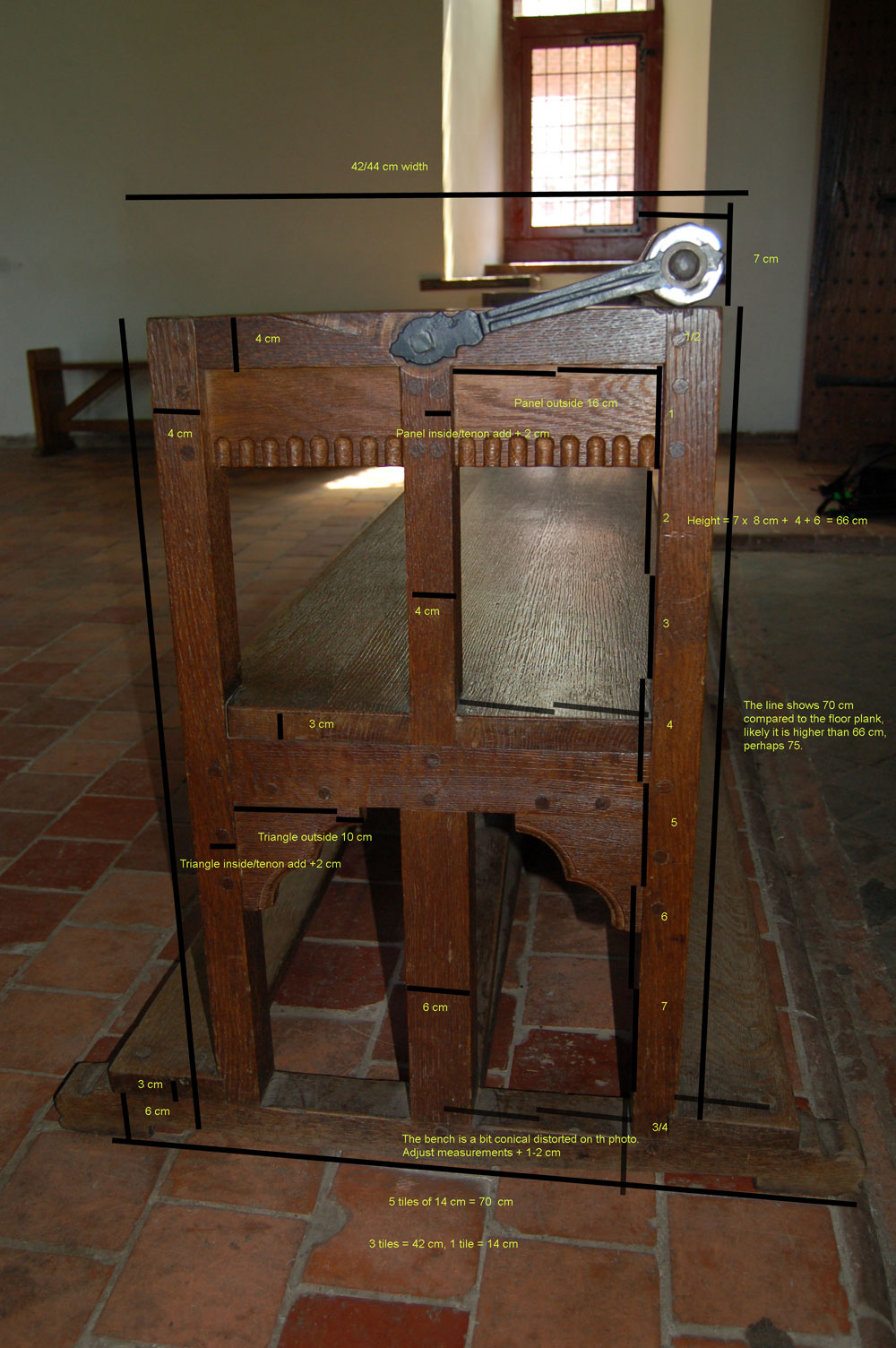
The replica strycsitten of castle Loevestein

The castle of Loevestein in Poederooyen, the Netherlands is famous for the escape of Hugo de Groot in a book chest during the 80 years war. The castle claims to posess the original escape chest (however they are not alone in that claim). Inside the castle some fine reproduction medieval furniture can be found, made by 'Vakwerk in Hout' (http://www.vakwerkinhout.nl/index.html). One of the pieces  is a large strycsitten which is displayed (and used) in the entrance room. This strycsitten looks similar to that on the painting of St. Barbara by Robert Campin.

Usually you can only visit the castle by guided tour, but they were willing to let me stay in the rooms and take measurements and photo's at leasure.


Of course the strycsitten is positioned in front of the hearth. Is is approximately 2.5 meters long and needs the support of the extra legs in the middle, as well as the diagonal beams. 


The three legs at each side of the strycsitten rest upon a wooden frame. On both sides of the strycsitten are foot rests attached to the same frame. The strycsitten is constructed using mortise and tenon joints, secured by wooden pins.


The turnable backrest has a metal (bronze) cover. Also the turning arm is of metal.


The underside of the strycsitten shows that the legs are only connected to each other on top by a central beam and by the wooden frame on the floor. The seating boards are loose, i.e. not fixed to the strycsitten.


This photo gives you an impression of the amount of persons seating on this strycsitten


Drawing of the side measurements of the Loevestein strycsitten.


drawing of the front and bottom measurements of the strycsitten


 Scetch of the underside of the seating. The shaded part is cut out for the diagonal beam.


I thought I had measured everything of the strycsitten, unfortunately at home I discovered I had forgot some, e.g. the exact height. Using my photos, sizes of the floor tiles and my drawings I reverse engeneered the approximate missing measurements.

Sunday, 16 January 2011

The medieval woodworkers toolbox

I have previously made an oak toolchest, which contains most of the tools the medieval woodworker used. Many tools have not changed in appearance during the last centuries, and are used in the same manner as in medieval (or earlier) times. At flea-markets or tool-collectors sites you might find items of the end of the 19th century / start of the 20th which are perfectly suitable for medieval re-enactment. Wooden tools we (of course) have made ourselves, while some other woodworking tools are reproductions custom made by specialist tool-blacksmiths.


What did the woodworkers toolkit in medieval times consist of? The booklet 'European woodworking tools 600-1660 C.E.' by G.R. Halstead (2003) list the following (conjectural) items for a medieval or renaissance carpenter:  
  • Hatchet, twybill, felling axe & broad axe
  • Gimlet, auger & brace
  • Compass, square & ruler
  • Grooving iron & twyvette
  • Saw
  • Adze
  • Plane
  • Chisel & gouge
  • Awl & marking gauge
  • Crowbar
  • Hammer
The inventory for a medieval or renaissance joiner is slightly different, as it has more types of planes and less axe types.
  • Set of bench planes
  • Three to four dozen moulding planes
  • Specialized planes (router, rebate, dado, plough)
  • Chisels & gouges
  • Mortising chisels
  • Mallet & hammer
  • Saws (crosscut, rip saw, fret saw)
  • Awl, marking gauge
  • Brace and bits, gimlet
  • Square, compass & ruler
  • Broad hatchet
These lists are not complete - for instance whetstones, indispensable for any woodworker to sharpen his tools are not mentioned. But to achieve completeness for a medieval woodworking toolkit is an almost impossible task. A good reconstruction of a woodworkers toolkit relies on four sources,( 1) surviving tools, e.g. those found at archeological sites, (2) artistic evidence, e.g. paintings and miniatures, (3) written evidence, e.g. invoices, testaments, housing inventories, or even poems, and (4) indirect evidence, e.g. toolmarks on surviving furniture and buildings. This is then interpreted with current woodworking knowledge, tradition and common sense.

Well-known archeological toolchest are the Mastermyr chest (12th century), tools found in wrecks of the Mary Rose and Vasa (16th & 17th century) and those of Elector August I of Saxony in Dresden, Germany. A good pictorial overview of woodworkers tools is found in the inventory made by Dr. Frieda Van Tyghem (1966) ‘Op en om een middeleeuwse bouwplaats’.

The tools in my toolchest are based on these sources. I will describe them in detail in future posts.


Friday, 7 January 2011

Strycsitten

I am currently making a so called "Strycsitten", a medieval bench with a turnable backrest. This type of  bench was usually placed in the house before the hearth; if one was warm one one side, the backrest could be turned and one would be heated on the other side. Strycsittens are frequently depicted in 14-16th century paintings and miniatures, especially by the Flemisch "Primitive" masters. For example, the annunciation (centre piece) of the Merode altarpiece by Robert Campin (Master of Flemalle). Unfortunately almost no original strycsittens remain.

Part of the Merode altar piece by Robert Campin showing a Strycsitten before the hearth.  
Around 1422, Metropolitan Museum of Art - Cloisters, New York, USA.

Basically "strycsittens" can be divided into three types, which I will call French, Flemish and German (based on their origin). The French type has the turnable point of the backrest attached near the seating. The sides are closed by panels. An existing example resides in the Rijksmuseum in Amsterdam, the Netherlands, another is found in the book of Otto von Falke (as the book was printed before WW2, I do not know if the bench still exist in the Berlin Museum).

 
15th century oak strycsitten from the Schlossmuseum Berlin, Germany. height 86 cm, width 194 cm, depth 55 cm.
In "Deutsche mobel des Mittelalters un der Renaissance" by O. von Falke.
15th century oak strycsitten. Height 75.5 cm, width 78 cm, depth 50.5 cm.  
Rijksmuseum, Amsterdam, the Netherlands


 Miniature showing a scolar in his room. At the back a strycsitten can be seen, covered with a cloth. From "Ung advis pour faire le passage d'outremer", ms 9095, fol. 1. Royal Library, Brussels, Belgium, around 1455.

A strycsitten by miniaturist painter Jean Bourdichon of around 1480. In "Les Quatre Etats de la vie de l'homme, l'Etat de richesse", Bibliotheque de l'Ecole nationale de beaux-arts, Paris, France.

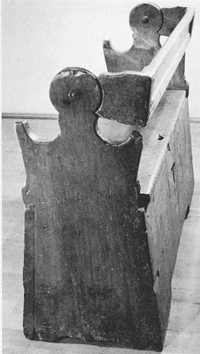
The German (and Scandinavian) type has a completely turnable back and armrest. Usually there is a chest beneath the seat. These type of benches were made from pine-wood. The book of Otto von Falke shows some existing examples.

End 15th century,  Museum Nurnberg, South Germany. Length 146 cm, height 77 cm, depth 37 cm.

Two strycsittens from the former collection of dr. Albert Figdor from the 15th century, shown from the back. (top) Origin Tirol, Austria, length 120 cm, height 90 cm. The front side has a decorated feet plank. (bottom) Origin Tirol, Austria, pine wood, length 158 cm, height 81 cm.

While the French and German types both have chest functionality under the seating, the Flemish type does not. It has four free standing feet and its construction is more open. Triangles carved with gothic architecture motifs strenghten the construction. The turnable point is usually attached to the armrest. This type is found on the paintings of Campin, Daret, etc. As far as I know, no original examples exist. The strycsitten at the Merode altarpiece has a frame filled with some kind of wicker-work as the backrest, which completely covers the back. Other Flemish strycsittens are described below.

St. Barbara by Robert Campin, 1438, Museo Del Prado, Madrid, Spain. The backrest is a simple eight-sided pole with an iron arm. The back pole rest on top of the armrest. A replica with this type of backrest can be found in Loevestein Castle in the Netherlands.  

Madonna at the hearthscreen by Robert Campin, around 1420-1425. This strycsitten is like that of the St. Barbara painting, but the back pole does not rest on the armrests, leaving place for the lions. 

 Jacquet Daret, Annunciation, around 1422. This strycsitten has the backrest at the same level as the armrest, which increases size of the armrest near the back. Koninklijke Musea voor Schone Kunsten van Belgie. Brussels, Belgium.

An almost identical strycsitten (and painting) is by the Meister von Schöppingen. Annunciation, between 1453 and 1457, parish church, Schöppingen, Germany. 

Often carved lions are found on top of the armrests of the Flemish strycsitten. These are religious motifs and signify the throne of Salomon, i.e. wisdom, and the strycsitten thus becomes the sedes sapientia. Therefore, we see the Holy Virgin (or St. Barbara) resting before the seat of wisdom.
The paintings show more interesting things related to the strycsitten. Frequently a separate foot rest is found. Furthermore the strycsittens are commonly covered with cloth and or cushions.

In next posts I will continue with the design and construction of my strycsitten.